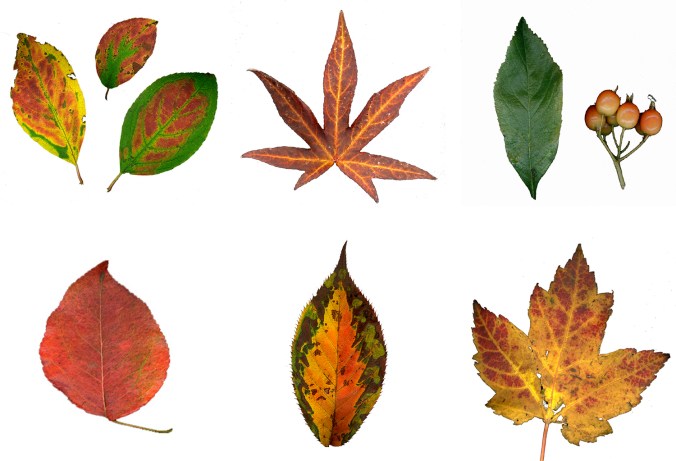
Pardon the rather overwrought title, but it’s true; an elementary school “Nature Collection” assignment changed my life.
It was also, at the age of 7, my first bitter taste of academic failure.
On the face of it, it was a rather fun assignment — go out into nature and make a collection of pods, seed and leaves from a variety of trees.

The one tiny problem was the complete lack of such trees anywhere near where I lived.
Most of my fellow pupils at Saint Andrew’s school, located in the middle of an English industrial city (Newcastle upon Tyne), probably shared my problem. Some of them may have lived within reach of Exhibition Park or the Town Moor, but I lived down on the Quayside. We had the Tyne river, docks, ancient buildings — but no sycamores, oaks or hazel trees for miles.

The Quayside in more recent years (2010). Our family’s flat used to be the area circled in red to the left of the photo. I was much more acquainted with the exact girder pattern of the Tyne Bridge just above my bedroom window than I was with the mysteries of trees.
Now, don’t misunderstand me, I loved growing up down there. In spite of the complete lack of any family-oriented facilities (including trees), it was a truly epic place for childhood adventure.

The High Level Bridge viewed from a part of the old walls where we liked to play. There are a few small trees growing there now, but it was mostly just weeds back in the 50’s and 60’s.
There were a handful of kids in the neighbourhood — my little brother and I, the two sons of the pub owner, and the two daughters of another bank caretaker.
We were “free range” and felt we owned the city.
The ancient city walls were our forts and houses, and many games were staged in the abandoned graveyard of All Saints Church.

All Saints Church had no congregation so it was left to turn into an overgrown adventure playground. Because the church itself was a protected historic building it was never demolished.
It didn’t occur to me for a moment that we were nature-deprived. There were, after all, plentiful weeds on the old World War II bomb-sites with which to create spectacular bouquets.

One of my favourite childhood bouquet ingredients. It’s called fireweed here in Canada, but in the UK it has the more poetic name “Rosebay WIllowherb.”
But the dreaded Nature Collection project was real eye opener. I’d never actually seen the sycamore trees it spoke of, with their clever little helicopter seedpods. I certainly had idea where to go and collect samples. My mum, who didn’t drive and had my little brother to look after, couldn’t really help, other that getting some books out of the library for me.
In the end I just handed in some pictures of the items we were supposed to collect. It felt like a massive failure.

Looking back, I feel some lingering annoyance that we were set an assignment so bound to fail. It was a classic curriculum vs real life mismatch.
On the other hand, it was a great gift. I feel as if I’ve been diligently working on that darn assignment ever since.
When I moved to other, greener parts of the world, I pressed all kinds of leaves and flowers in books. Sometimes I composed pictures of with the dried results and sent them to my mum back in Newcastle. I recently came across a few ancient specimens in my massive copy of Wild Flowers of the Pacific Northwest.

I still feel a thrill, fifty plus years later, every time I come across any new or particularly beautiful little specimen of leaf, seed, fungus, nest or moss.
Or crow, come to that. We only saw pigeons and gulls down on the Quayside.

I’m always especially thrilled to see the ways in which nature and the city intersect
I love to see a weed forcing it’s way through asphalt, or human rubbish selected by birds to furnish their nests.

I found this fallen and abandoned bushtit nest and “collected” it earlier this year.

Detail of the bushtit nest. Construction materials include moss, spider webs (for strength and stretch), leaves, grass and fragments of man-made fibres.
This crow’s nest I found on the ground recently is a great town bird/country bird collaboration – an ingenious mix of twigs, moss, twine, packing fluff and zap straps.
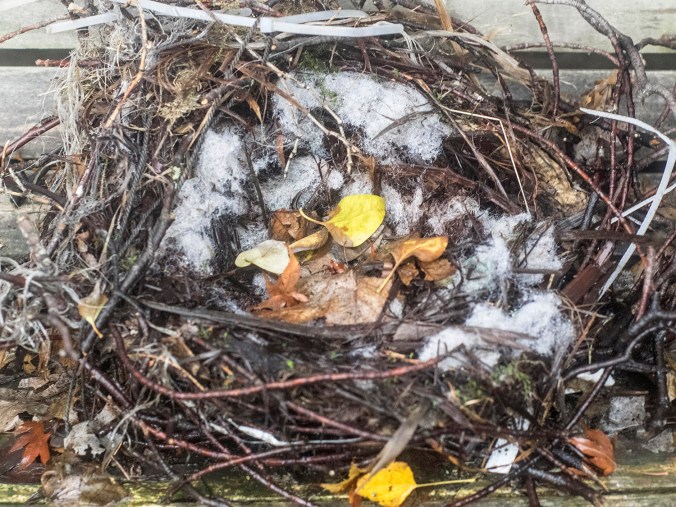

So, every piece of moss or rust, every bird I see; every lovely fallen leaf that catches my eye; it’s all being mentally added to the ongoing “Nature Collection” project.