Consider the Grackle …

You see a loud, smart, black bird, hanging around with his gang of mates, giving you fearless looks, and constantly rummaging through the garbage (or your picnic) for a snack.

Must be a crow, right? Or at least a corvid relation?

But no, the grackle isn’t even distantly related to the crow. It’s a member of the Blackbird family, which includes the Brewer’s and Red-winged Blackbirds that we see in the Pacific Northwest, as well as Cowbirds and Orioles.

We went to Mexico last winter and as soon as we got out of the airport  I started noticing these cheeky, opportunistic birds.

They seemed to be everywhere, always with a beady yellow eye to the main chance.

In the absence of any crows, the grackles began to occupy the part of my brain that is usually filled with corvid observations.

The grackles we saw in Mexico were of the Great Tailed variety (Quiscalus Mexicanus). Locally, they’re called Zanates.

In comparison to crows, they’re a lot more streamlined, with light gold-coloured eyes, and legs that go on forever. The males have a long, impressive (some might say, “great”) tails, and a have vivid blue and violet sheen to their feathers.

The females are much, much smaller (about half the size), with more modest tails and dullish brown feathers.

Her and him doing a bit of foraging in the sand, as  you do …

They’re so different that it took me a while to realize that they’re the same species — I thought for a long time that they were two kinds of grackle that just liked to hang out together.

Female Great Tailed Grackle paddling at the beach.

We did see a dazzling variety of birds in Mexico (pelicans, spoonbills, herons, parrots, hummingbirds, chachalacas, caciques, woodpeckers, buntings, doves, cormorants …) but, for some reason the grackles kept calling to me. I guess I just can’t resist a bird that looks me right in the camera lens and dares me to press the shutter.

Buzz off,  paparazzi!

Look out, make way for the Great Tail.

Like crows, the grackles could be pretty raucous. Here’s one making some sort of statement in the early morning near our hotel. Luckily we were up early anyway, on the search for the elusive red cardinal that paid a fleeting and tantalizing visit on the first day, never to be see again. But that’s an entirely different story.

NOTE: video follows. If you’re reading this in an email, the video won’t play. To see it click HERE to go to the actual blog post.


Once I got home to Vancouver I planned to do some more research and write a blog about the grackles, but, what with one thing and another, the cheeky grackles slipped my mind and that mental space got recolonized by corvids.

Luckily I was reminded about grackles last week when I got an email from a friend who’s in Mexico now. She was wondering about the crow-like black birds she was seeing everywhere …

My interest rekindled, I started going through my photos from last year and doing a little more research. I’d looked up Great Tailed Grackles online when we were in Mexico —enough to identify them and glean a few facts — but our internet was a bit dodgy, and there were other distractions of course, so I didn’t get too far.

The ingenious modem set up at our hotel in Mexico.

My recent online search for grackle facts turned up news of  a fascinating study by Corina Logan of Cambridge University. The Great-Tailed Grackles she encountered in Costa Rica  reminded her of crows, and spurred her to wonder if they shared any of that famous corvid intelligence. In 2016, at the university of California, she performed some tests to find out. A series of food acquisition challenges she set for them proved that, like crows, they were very good at deploying a variety of solutions to solve different problems. This particular skill is known, in bird scientist lingo, as “behavioural flexibility” and understanding it is an important piece in solving the bird intelligence puzzle.

Famous crow expert, John Marzluff, commented on the study, saying that Logan’s study “ clearly demonstrated variability that different individuals have when it comes to learning. That’s really cool. You’d see the same thing in people.”

So crows and grackles, apart from the casually observed similarities, also share a special avian ingenuity. I don’t know if they overlap in any territory and, if so, I wonder if they compete, or use their street smarts to divide up the neighbourhood like avian gangs.

Does anyone reading this live in a place where Great Tailed Grackles and crows both reside?

UPDATE: For an answer to the above question,  see Crow vs Grackle.

With brains like ours, the sky’s the limit.

If you’d like to keep reading about grackles, I found an very entertaining article by   John Nova Lomax  entitled Eight Reasons Why Grackles Are Awesome, published by Texas Monthly.  His attitude to grackles reminds me of mine towards crows here in Vancouver.

Postscript

I did see one member of the corvid family when we were in Mexico. The Urraca or White Throated Magpie Jay was sometimes to be found on our early morning bird watching walks. An impossibly exotic looking bird, with a “fascinator” head adornment, it would not have looked out of place at a royal tea party. I’d have liked to spend more time with this bird, but it was a lot harder to spot than the ubiquitous, and always entertaining, Grackle.

www.junehunter.com

SOME RECENT POSTS ABOUT CROWS

Crow Stories

Crow Gossip


A Puzzlement of Crows

SaveSave

SaveSave

SaveSave

SaveSave

SaveSave

SaveSave

SaveSave

SaveSave

SaveSave

SaveSave

SaveSave

SaveSave

SaveSave

SaveSave

SaveSave

SaveSaveSaveSave

SaveSave

SaveSave

SaveSave

SaveSave

SaveSave

SaveSave

SaveSave

SaveSaveSaveSaveSaveSaveSaveSave

SaveSave

SaveSave

SaveSave

SaveSave

SaveSave

SaveSave

SaveSave

SaveSave

A Puzzlement of Crows

It’s taken me a ridiculous length of time to get to this simple little blog . I’m just trying to update you on the WHO, WHAT and WHERE of the local crow families. But it’s complicated!

I tried writing it all in words and it was confusing even me, so I decided we needed a map. Voila!

Honestly, I did feel as if I could use something fancier, like the opening credits to Game of Thrones to do the situation justice but, alas, the budget is limited and so the map will have to suffice.

In the post-summer corvid reshuffle, you can see we have four families vying for hegemony* in this little corner of East Vancouver.

Let’s have a look at the protagonists in this little neighbourhood drama.

MABEL

Normally, at this time of year, George and Mabel would have returned from their nesting area at the west end of the block to reclaim our alley way and my back garden.

Since the sad death of George this summer, Mabel seems happy to stay in the nesting area with the junior crow that she and George fledged the summer before last. They claim the elementary school end of the block and the alleyway to the south of our house.

ERIC & CLARA

Eric and Clara are sticking to their traditional territory which includes the south side of Notre Dame School (including the highly prized school dumpster in the parking lot), the east end of Parker Street and points west along Parker to Rossland Street. Of course, their jurisdiction includes the all-important ceremonial fire hydrant.

Sometimes they will make a sortie to my front gate if they see me coming out with the dog, or going to the car. They will also venture part way down “Mabel’s” alley, but turn back at “her” Hydro pole.

Eric takes his Block Watch duties very seriously.

They didn’t have any baby crows this spring. The nest they were working on blew away in an early summer windstorm and they didn’t seem to have the heart to start over.

THE FIREHALL FAMILY

The Firehall pair, on the other hand, had a very successful baby-raising year.  They have three surviving adolescents — quite an achievement, given the long drought and tough conditions this summer. Their little population explosion has been one of the major factors causing a fluctuation in the customary corvid boundaries.

The Firehall Triplets

I imagine the three young ones will soon go off and start their own little empires elsewhere but, for now, with five mouths to feed, they’re venturing out of their usual stomping grounds.

Crowded up there on the Hydro wires.

They’ve even had the nerve to go and try pinching peanuts off Eric’s fire hydrant. Such audacity is met with firm resistance. They also come to my back fence sometimes. They’ve never done this in previous years and their visits have led to some minor scuffles with Marvin and his mate.

MARVIN & MATE

In the summer months, when George and Mabel would abandon my garden for their nest site to the west, a notice must immediately have gone up on the Corvid Craigslist. I imagine it read something like: “Temporary vacancy in well-appointed garden with well-trained, peanut-serving human.” This year our summer tenants were a crow with paint on his neck and a  companion with the colourful feathers of a younger crow.

I believe that the crows that are most often coming to the garden now that it’s fall, are these same two — but it’s hard to tell for sure as the late summer moult took care of the  easy-to-spot painted and the colourful feathers, leaving us with two anonymously glossy black crows. I think, from their behaviour, it’s the same two. I’ve called the formerly painted crow Marvin after Lee Marvin, who starred in the movie, Paint Your Wagon, many years ago. I haven’t yet got around to a name for his mate. Indeed, I don’t really know who’s “he” and who’s “she” for sure at the  moment, but you’ve got to start somewhere.

We’re beginning that fun “getting to know you” routine, which involves a lot of “risk/benefit” calculation on their part. You can almost hear their brain cogs whirring as they try to figure out how close it’s safe to get to this crazy human and her dog.

They don’t look too dangerous …

How about from this angle?

I feel safer up on the roof.

Hmmm….

Gradually, they’re getting bolder. Or possibly just more desperate as the weather takes a turn for the worse and they settle in for the winter. I think we’ve even got to that cosy stage where they blame me for the weather.

So, for now, things are a bit fluid — and I don’t just mean what’s coming from the sky. When a crow shows up in my garden at the moment, it’s a bit of a guess as to whether it’s Marvin & co, or a Firehall visitor, or even Eric and Clara, testing the northernmost limits of their territorial boundaries.

This time last year I was pretty sure who was who, and now it’s like starting the puzzle over. But, hey, I figure it’s good exercise for my aging brain. I’ve never tried Sukuko, but examining and sorting all of the corvid “who’s who, and where?” clues has to be almost as good.

NOTE    * I have been waiting for 40+ years to use “hegemony” in a sentence. I believe I first came across it when reading about the foreign policy of Frederick the Great of Prussia for a very boring university essay in the mid-70’s. I knew it would come in handy eventually.

www.junehunter.com

A new project I’m working on — crow shapes with rust and other textures. Watch out for them in my online shop in the next week or so.

SaveSave

SaveSave

SaveSave

SaveSave

SaveSave

SaveSave

SaveSave

SaveSave

SaveSave

SaveSave

SaveSave

SaveSave

SaveSave

SaveSave

SaveSave

SaveSave

SaveSave

SaveSaveSaveSaveSaveSave

SaveSave

SaveSave

SaveSave

SaveSave

SaveSave

SaveSave

SaveSave

SaveSave

Dishevelled Crows

My mother had a storehouse of wonderful sayings — one for every occasion, really.

If I was looking particularly unkempt (a look I actively cultivated in my hippy days, but that’s an entirely different story) she’d say I looked as if I’d been “dragged through a hedge backwards.”

Sometimes, at the end of a particularly hard day of cleaning and chores, she’d describe feeling like “the wreck of the Hesperus.”

I’m reminded of both sayings every time I go outside at this time of year and see the state of the local crows.

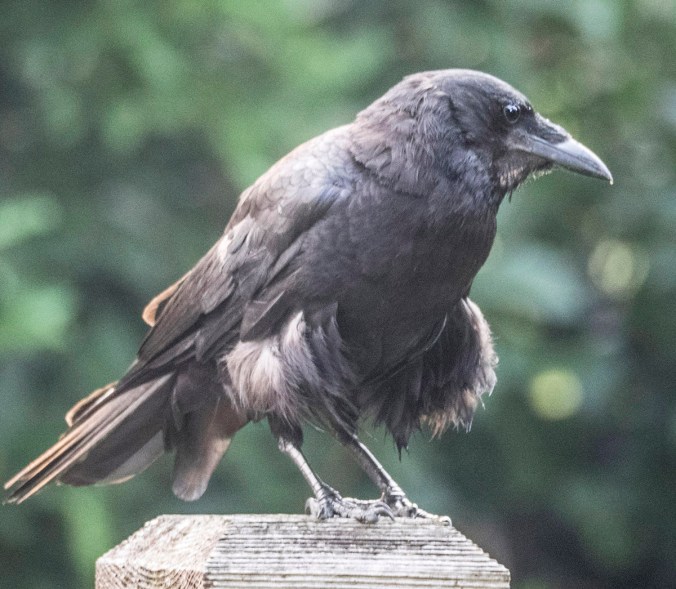
They always look bedraggled at this stage of the molting season, but the seemingly endless, long, hot summer seems to be making them even more tattered and grumpy-looking than usual.

Feathers do not last forever, and after a year of hard service, the crows’ feathers begin to lose their glossy blue-black patina and become dull, with muted shades of sepia and grey. Luckily they have the ability to grow a new set of spanking new ones, but this metamorphosis comes at a cost. The process takes a lot of energy, which is why it’s usually timed for a period of relatively low corvid activity — after nesting and before migration (for those who head to warmer climes for winter). They need rest and good nutrition to grow the new feather cloak and hormonal changes associated with the process can make them feel out of sorts.

This summer, with no rain to speak of in months, it must be especially gruelling. Food sources, and even water, are harder to come by than usual. I’ve been putting out a couple of bowls of water in my neighbourhood for Eric and Clara and the harried parents of the Firehall Triplets. I feel especially sorry for the molting crows with young ones, as they have to find food for extra mouths — and deal with the loud and  constant appeals for food.

The Firehall Family

Although they continue to try their luck at getting the parents to feed them, the fledglings are, by now, capable of doing some of their own foraging. The photo above was taken just this morning. The parent crow ignored that gaping pink beak and flew off with most of the peanuts I’d left. There were a couple left in the grass, and junior eventually got the hint and picked them up himself.

Baby crow figuring out if the leaves of my neighbour’s squash plants are “food.”

Warning: This is a risky vantage point from which to take a photo of a baby (or any) crow.

Eric and Clara

This is Eric, described by my husband as “the James Bond of crows” for his usually sleek unruffled feathers, and manner.

As you can see, even Eric the Suave is looking rather ragged and disgruntled these days.

Eric and Clara this morning. Only 8am and it’s hot already!

Mabel

Mabel can be found every morning just down the alley from Eric and Clara. Here she is, her faded feathers looking almost as colourful as the towels on the washing line behind her.

Painted Crow

My new pal has conveniently marked him- or herself with some paint around the neck, aiding in instant identification. It’s already fainter now and I guess the little paint mishap will be a distant memory when the new feathers come in.


So, when you slip on your new back-to-school or back-to-work outfit, spare a thought for the poor crows who have to grow their own.

It’s an arduous process, and I’m sure they’ll be mightily proud and relieved when their fall wardrobe finally comes in.

www.junehunter.com


Crow calendars now available online, or at the studio sale.