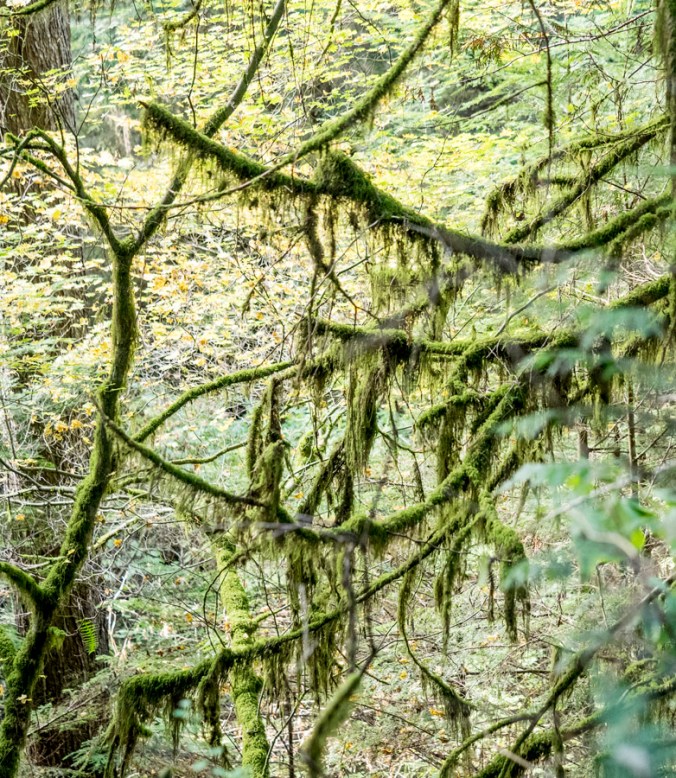
Forest Bathing

sun in trees

Sometimes a little dip into nature does the trick, but sometimes, nothing short of full woodland immersion is going to work.

Most days my spirits can be revived by a quick dog walk round the block, appreciating the changing leaves, a bit of moss here and there. The crows, of course.

Last week though — I’m not sure it was a touch of flu, too much turkey at Thanksgiving, or watching the second US presidential debate — but I was running on my last cylinder.

Although I felt mostly like sleeping, we went for a walk around Lynn Headwaters Park.

OLYMPUS DIGITAL CAMERA

Because fierce rain and windstorms were predicted, last Wednesday seemed bathed in a golden light. It was a perfect fall day, all the more special for the impending weather doom and gloom.

Also, I hadn’t been in the woods for several weeks due to a series of unfortunate lower leg events. I hadn’t realized how much I missed it.

Three hours felt like the equivalent of a week’s magical vacation.
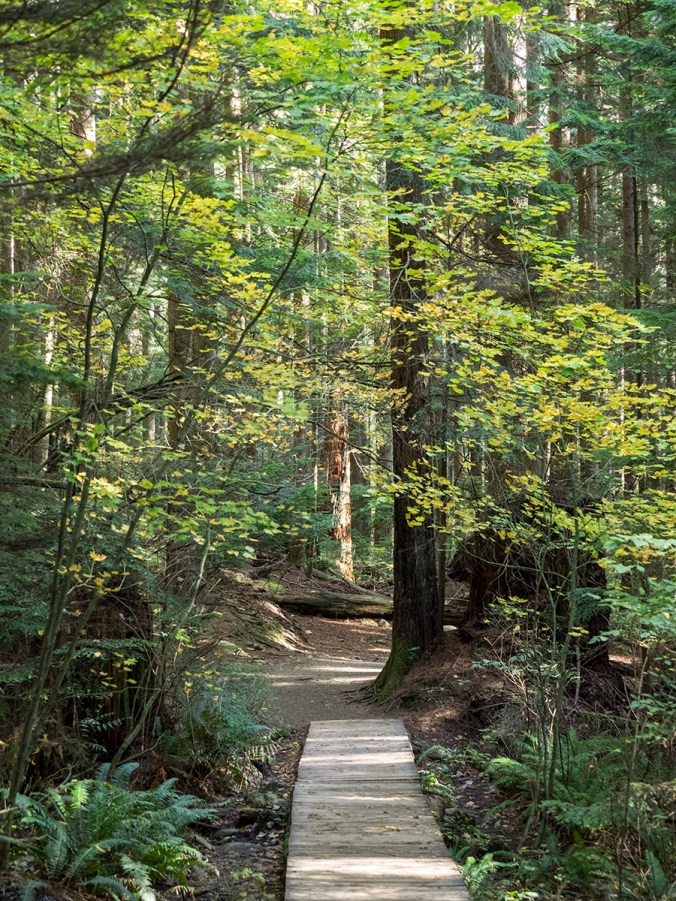
Coincidentally, ever since then I’ve been seeing the Japanese practice of “Forest Bathing” or “Shinrin-Yoku” popping up on my social media, and even in today’s local paper. If you Google the term “forest bathing” you’ll see that everyone from The Globe and Mail to Oprah is talking about it.

It seems that something we’ve always known intuitively is backed up by science. A walk in the woods is good for your health — physical and mental. No need to work up a sweat either. It’s simply being in the presence of trees that provides the benefit.

So, if you can, get out and find some trees to bathe with right now.

If you can’t fit it into your schedule immediately, I hope you’ll enjoy these photos.

Think of it as just a preview of your own real woodland walk, coming soon.

OLYMPUS DIGITAL CAMERA

OLYMPUS DIGITAL CAMERA

OLYMPUS DIGITAL CAMERA

OLYMPUS DIGITAL CAMERA

Lynn waters

Should you ever doubt the calming effect of a woodland walk, compare Geordie’s before and after pics.

anxious-geordie

BEFORE – in the car on the way to the park. Geordie always suffers a bit of car-ride anxiety, worrying perhaps that we’ve changed our mind and are returning him to the shelter in California whence he came.

AFTER: Geordie, blissfully one with nature.


www.junehunter.com

logo with crow

Hug a Crow This Earth Day

Not literally, of course. Crow hugging is fraught with peril at the best of times, but especially in spring when nesting season has them a bit tense.

Baby Face Crow © June Hunter Images

Please, do not hug me.

But I do suggest that you give the crow (or pick your favourite bird, plant, patch of moss or mollusk) a special thought today.

OLYMPUS DIGITAL CAMERA

coral bark maple © June Hunter Images

mussels at Botanical Beach © June Hunter Images 2016

It’s Earth Day so, ideally, we should be extending our love to the entire planet.

But that’s a hard thing to do, particularly when what the planet needs from us right now is massive change —change that is going to be really tough for us to make.

John Marzluff quote2

The majority of the world’s population now lives in cities, where we often feel very cut off from what we think of as Nature.

Lyanda quote

So, given that most of us are urbanites these days, how are we to develop the necessary connection with nature in order to care enough to make change and move towards saving the planet?

As my dear mother used to say, “wherever you go, there you are.”

And where you are now, even if it’s in the heart of the city, has tenacious bits of nature thriving in it.

It just takes a slight focus shift to start becoming aware of, and amazed by it.

OLYMPUS DIGITAL CAMERA

This crow is tending a nest at Hornby and Robson in the heart of downtown Vancouver, right by the Art Gallery. A friend who works at the gallery told me that it’s probably the same pair who nested there last year and caused a traffic kerfuffle when one of their babies flew into the back of someone’s convertible just outside of Café Artigiano.

OLYMPUS DIGITAL CAMERA

Collecting nest furnishings in the heart of downtown Vancouver.

Often the thing you tend to notice first, just because of its size and boldness, is a crow.

CameliaCrow ©June Hunter Images 2016

I find that the crow is your gateway bird, leading to the habit of noticing the bird world as a whole. Once you’ve started to look up to see what the crows are up to, you can’t help but start to notice the robins, sparrows, bushtits, chickadees and hawks going about their more subtle, but equally fascinating, avian business.

Bushtit in the Rain © June Hunter Images 2016

Coopers Hawk on William © June Hunter Images 2016

Chickadee in the Snowbell Tree © June Hunter Images 2016

And noticing birds is, in turn, a gateway to the wonder of nature in general.

Colin Tudge quote

The task of saving the earth often seems far too big and therefore hopeless.

The tools we need this Earth Day are empathy and hope.

Someone who embodies both of these qualities is 87 year old Jean Vanier, who created L’Arche — a unique and loving community for mentally disable adults. Here are some of his thoughts on birds, as told to columnist and writer, Ian Brown in a Globe and Mail interview.

Jean Vanier quote

Eric and Erica on Roof

Hmmm, something to think about …

logo with crow


Some notes on the author’s quoted in this blog post:

John Marzluff’s Wikipedia page says this:
“John Marzluff is a professor of wildlife science at the University of Washington and author of In the Company of Crows and Ravens, Gifts of the Crow, and Welcome to Subirdia. His lab once banded crows with a Dick Cheney mask.”
— so you know he’d be fun guy to know!
Subirdia is his most recent book about the amazing adaptability of birds, their importance, and what we can do to help them survive in our urbanized world.

I first discovered Seattle author Lyanda Lynn Haupt when I picked up a copy of Crow Planet several years ago. It remains one of my favourite books, combining science, poetry and humour  in a way that I could read all day. She’s also written a wonderful book on city wildlife in general (The Urban Bestiary) and I look forward to her next one on the subject of starlings. And she has a blog: The Tangled Nest.

Colin Tudge is a British biologist and entertaining author, The Bird is only one of many books he’s written. I next want to read his book The Secret Life of Trees.

You can read more about the life and work of  Jean Vanier on his website.

Ian Brown is an author and  columnist for the Globe and Mail newspaper. His books include Boy in the Moon, about his severely disabled son and his latest, Sixty, The Beginning of the End, or the End of the Beginning?  That one’s also on my reading list.


Black and White World

Raven Departure


I love colour. I really do love colour.

But there is something very beautiful in a landscape stripped down to shades of black and white.

Stark and simple.

Here’s a little photo essay on a lovely world almost devoid of colour.


Calligraphy in the water at Hastings Sanctuary

Calligraphy in the water at Hastings Sanctuary


Pair of ravens at Bowen Lookout, Cypress Bowl

Pair of ravens at Bowen Lookout, Cypress Bowl


Snow, trees and sky. Mount Washington, Vancouver Island.

Snow, trees and sky. Mount Washington, Vancouver Island.


Raven call

Raven call

Raven reverse.

Raven callback.


Garry oaks on Hornby Island

Garry oaks on Hornby Island


Raven tracks


OLYMPUS DIGITAL CAMERA

Fluffy raven at Bowen Lookout, Cypress Bowl, West Vancouver


Winter Tree

Tree skeleton


Raven acrobat. This is tricky, especially in a brisk wind.

Don’t try this at home.


Winter skyline with raven.

Winter skyline with raven.


George says hello in black and white.

George says hello in black and white.


logo with crow