The Calligraphy of Crows

This is an excellent time of year for studying crow calligraphy.

Their inky brush strokes are never more distinct than when scrawled across the blank parchment of a pale grey Vancouver winter sky.

The bulletin can be simple — “yup, it’s grey and boring down there in the human world, but every day is an adventure for us crows!”

Yahoo!!!

Often though, the fleeting sight of a crow in an urban setting seems like a cypher — a key to de-coding a much bigger message.

As we dash around in the city it’s sometimes possible to forget that nature even exists.

Even if I try my hardest to feel connected, so many things can seem to stand in the way; the constant metropolitan hum-m-m of sound; getting from A to B;  worrying about paying bills, meeting deadlines, not getting run over; the latest news …

I know there’s another storyline beyond it all — one that I really need to pay more attention to.

I know I’d feel better if I could tune into it, but can’t for life of me quite remember how it all fits together.

It’s like a neglected language.

One I’ve never been fluent in.

I’m sure I once knew how to hold a rudimentary conversation, but now the grammar eludes me.


Then, one random day, I look up and see four crows rolling and tumbling in the sky and then snapping  back into a purposeful formation.

For reasons I can’t understand it brings to mind just one key bit of the syntax.

Like stumbling across part of a cypher to that complicated secret message — never quite enough information to crack it entirely, but offering a glimpse.

Everything does not suddenly make sense — but I am at least reminded that the other language exists.

I still don’t see the answers, but there’s a certain joy now in the not knowing.

I hope to spend more time in 2023 paying attention to, and working with, crow calligraphy.


________________________________________________________________________________________

© junehunterimages, 2023. Unauthorized use and/or duplication of this material without express and written permission from this blog’s author and/or owner is strictly prohibited. Excerpts and links may be used, provided that full and clear credit is given to junehunterimages with appropriate and specific direction to the original content.

Ode To The Starling

‘Tis the season of starry, spangled things and thus seems a good time for a post in praise of the humble starling.

Many find starlings to be a bit of a problematic bird here in North America.

Invasive, too many of them etc.

I could explain how it’s not their fault that some enthusiastic but misguided human immigrants to 1890’s New York thought it would be a great idea to try and introduce every one of the birds mentioned in Shakespeare’s plays to North America by releasing them in Central Park.

Also not the starlings’ fault that they proved to be by far the scrappiest and most adaptable of all the birds involved in this ill-conceived project, going on to colonize most of the continent and reaching their current  population of more than 200 million.

But, you know (as one of my favourite authors, Lyanda Lynn Haupt, noted in her book Crow Planet)  we humans do end up with the birds we deserve. Often we end up with much more  than we really deserve, in fact.

Starlings at the Still Creek crow roost, winter 2022

People have been a lot more invasive and destructive than any bird, and as we continually modify the landscape for our own purposes we crowd out a lot of the more sensitive and specialist birds, leaving more room for the opportunist and generalist starlings.

And crows, of course.

Starling and crow, sharing the view

While we mourn the decline of many native birds and do our best to lobby for the maintenance and  restoration of their habitat, we can also keep our spirits up by enjoying the rabble rousing birds we do see every day.

Lyanda Lynn Haupt also wrote about starlings.

Her book Mozart’s Starling is about the bond between the composer and his pet/muse starling; about Carmen, Lyanda’s rescue starling and much loved family member; about the incredible personality and vocal complexity of the starling; and (a theme running through all her books) about wonder …

“But the earth and its beings are extravagantly wild, full of unexpected wonders. It is time to turn from our textbooks and listen to the birds themselves.”

Lyanda Lynn Haupt, Mozart’s Starling


So let’s have a look at the joy to be found in these starry, fizzy birds.

As always, poet Mary Oliver says it perfectly …

Chunky and noisy,
but with stars in their black feathers,
they spring from the telephone wire
and instantly

they are acrobats
in the freezing wind.
And now, in the theater of air,
they swing over buildings,

dipping and rising;
they float like one stippled star
that opens,
becomes for a moment fragmented,

then closes again;
and you watch
and you try
but you simply can’t imagine

how they do it
with no articulated instruction, no pause,
only the silent confirmation
that they are this notable thing,

this wheel of many parts, that can rise and spin
over and over again,
full of gorgeous life.

Ah, world, what lessons you prepare for us,
even in the leafless winter,
even in the ashy city.
I am thinking now
of grief, and of getting past it;

I feel my boots
trying to leave the ground,
I feel my heart
pumping hard. I want

to think again of dangerous and noble things.
I want to be light and frolicsome.
I want to be improbable beautiful and afraid of nothing,
as though I had wings.

— “Starlings in Winter” by Mary Oliver, Owls and Other Fantasies: Poems and Essays


While many think of starlings as rather drab brown or black birds, their colours are actually among the most spectacular of our local birds — once you see them in the right light.

Indigo, aquamarine, periwinkle, lavender and midnight are all there, tipped with stars of white and pale ochre, all shifting and threatening to vanish as the bird moves in and out of shadow.


As with crows, you can almost always spot an anonymous starling somewhere in the landscape — looking reasonably poetic for a “pest.”

Often, you can see hundreds of them at once …

<

Visitors to the Burnaby crow roost at Still Creek will notice that the thousands of crow visitors have now been joined by a large starling contingent.We don’t seem to get quite the volume of starlings necessary for the breath-taking murmurations I’ve only seen in videos.

Here’s a particularly lovely sequence by wild life cameraman and travel journalist Dylan Winter: https://www.youtube.com/watch?v=eakKfY5aHmY
British writer Helen MacDonald eloquently describes and explains the logistical marvel of a starling murmuration in her essay, The Human Flock:

The changing shape of starling flocks comes from each bird copying the motions of the six or seven others around it with extreme rapidity: Their reaction time is less than a tenth of a second. Turns can propagate through a cloud of birds at speeds approaching 90 miles per hour, making murmurations look from a distance like a single pulsing, living organism.

 — Helen MacDonald, The Human Flock


Now, zooming back in from the thousands of starlings to one particular bird …

… this is Sparky, a lame-footed fellow who’s been visiting me for over a year now. He manages to grab the odd peanut when Marvin and Mavis aren’t looking and always has a lot of bubbly and vaguely pinball-arcade-sounding things to say.

Sparky last spring. Note the grey tinge to the base of the beak which is a clue that he’s a male. The females get a more pink colour during breeding season.

This focus switch from the the anonymous flock to the individual bird takes me back to Helen MacDonald’s essay in which she reminds us that even what looks like “a single pulsing, living organism” is also, miraculously, made up of many individuals, each with their own story.

“in the face of fear, we are all starlings, a group, a flock made of a million souls seeking safety”.

Helen MacDonald, from The Human Flock (an essay for the New York Times)

This post is for my friend, Debbie — a lover of many birds, but especially the effervescent starling.

________________________________________________________________________________________

© junehunterimages, 2022. Unauthorized use and/or duplication of this material without express and written permission from this blog’s author and/or owner is strictly prohibited. Excerpts and links may be used, provided that full and clear credit is given to junehunterimages with appropriate and specific direction to the original content.

The Amazing Long-eared Owl

Crows bring people gifts.

The gifts most often talked about are the tangible kind — little bits and bobs left by crows for their human friends, seemingly in gratitude for peanuts or other treats.

But the bigger gift they give, for me at least, is their habit of yelling at me “Oi, you! Yes — you! Come over here and have a look at this, right now!” on a regular basis.
When I hear the crows making a ruckus I always, if I possibly can, change plans and go see what it’s all about.

Invariably, it’s something.

Occasionally, it’s something amazing.

Always worth the diversion!

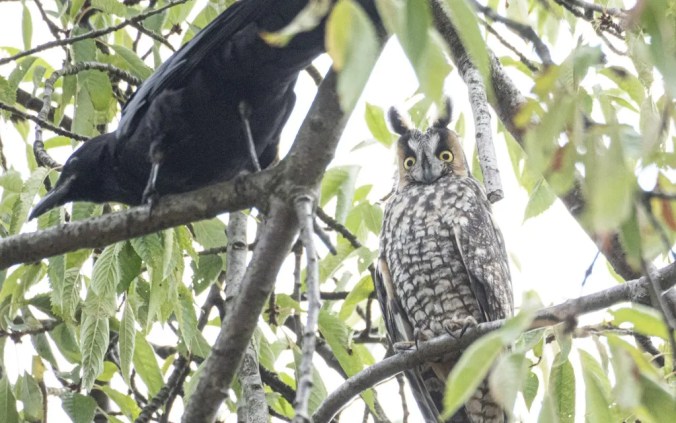
Yesterday, Geordie and I set out on the morning walk, following the usual route to say hi to the Walkers and Wings when crows from near and far started flying over us to a tree a couple of blocks north. They were kicking up a crowcophany audible around the neighbourhood.

Naturally, we immediately made a sharp detour to see what was going on.

I peered at the tree from a variety of angles but couldn’t see what the fuss was about until a woman walking by on the other side of the road said she could see something —maybe an owl!

Not only was it an owl, it was an owl with what looked like ENORMOUS ears. I had a quick look at my Sibley’s bird guide phone app and thought that ears of this magnitude could only belong to the aptly named Long-eared Owl. But, reading on, I saw they were “rare or uncommon” — so that didn’t seem too likely for an urban East Vancouver street tree.

Various other neighbours, of the human variety, stopped by to see what the crow noise was about and we all gazed up into the branches. It was a “Where’s Waldo” situation as the owl was so well camouflaged, and the tree so big, that if you took your eyes off it for a moment it was really hard to locate again.

After about half an hour, most of the crows moved on to other crow business, leaving just the local family to keep an eye on the owl interloper. They would ignore the visitor for a while, pecking around nearby lawns in search of worms and then come back every 15 minutes or so for some pro forma cawing — just in case the owl was getting ideas.


Here’s how All About Birds describes the Long-eared Owl …

http://www.allaboutbirds.org
Long-eared Owls are lanky owls that often seem to wear a surprised expression thanks to long ear tufts that typically point straight up like exclamation marks. These nocturnal hunters roost in dense foliage, where their camouflage makes them hard to find, and forage over grasslands for small mammals. Long-eared Owls are nimble flyers, with hearing so acute they can snatch prey in complete darkness. In spring and summer, listen for their low, breathy hoots and strange barking calls in the night.

Surprised expression … check!

All owls excel at looking surprised, but this one definitely earned top marks for channeling pure astonishment.


Long ear tufts like exclamation marks … check!

These aren’t the owl’s real ears — just rather spectacular feather tufts called plumicorns. The word comes from the Latin words pluma (feather) and cornu (horn). The purpose of these feather horns remains a bit of a mystery although it’s likely a way for the owl to look fiercer and bigger when under threat. Another theory is that it helps with camouflage, breaking up the bird’s silhouette and allowing it to blend into a a woodsy background more effectively

The owl’s actual ears are cavities below the plumicorns, asymmetrically positioned on each side of the head. This asymmetry enables the Long-eared owl to hone in on prey by sound alone. The location of the tiniest sound (a leaf or blade of grass rustling, a small movement under a foot of snow) is narrowed down by the way the sounds arrive at each ear cavity at minutely different times, telling the bird whether dinner is to the left or right, up or down.

If you’d like to read more about the marvel of owl hearing and navigation, there are all kinds of amazing articles available. Owls and Owl Hearing is one of them.

Hey, check out my groovy plumicorns!

Owls always seem relatively relaxed when mobbed by crows. This owl was pretty small — about the same size as the crows, so you’d think they might feel threatened.

A glance at the heft of the their feet and the dagger-like sharpness of those claws may give a clue to why they seem so unworried by the crow clamour.

I’m not sure why this lovely owl was caught out in the open in the daylight like this. Perhaps they got carried away with hunting the night before and didn’t leave enough time to get to a more private place for day-time rest. We went back this morning to see if he or she was still there — which would have been worrying  — but saw no sign of them.

I hope, like the barred owl that rested in a tree in front of our house for a whole day a few years ago,  this Long-eared relative just waited until dusk until it was time to fly off into the darkness and become a hunting ghost — and that, today, they’re sleeping peacefully in a more tranquil location.

Oh, and I’m pretty certain now, rare or not, this was in fact a Long-eared owl, bringing an amazing day to our rather urban little neighbourhood.

Sibley’s Field Guide to Birds section on Long-eared owls

This owl was so well camouflaged in the tree there’s no way at all I would have spotted him or her without the crows leading me.

I know the crows had their own reasons for kicking up a fuss — owls are on the crow “naughty list,” along with any other creature that will prey on adult or fledgling crows or eggs — and so will be mobbed by the well organized Crow Cooperative in order to encourage the danger to move on to less rowdy prey.

Crow don’t waste their energy on these loud protests, so it’s always worthwhile to go check them out. While helping us with birdwatching isn’t their goal, it’s a service they do offer if we’re willing to take the help.

Just happening to see amazing birds while watching crows is a little different from “regular” bird watching in that you have to wait for the sighting to come to you, rather than seeking it out.

And, when it does come, out of the blue, it feels more like a gift that a personal achievement.

Other “gifts” I’ve been given by following crows include a juvenile eagle, other owls, coyotes, raccoons, a peregrine falcon, hawks, ravens and, one especially miraculous day, a runaway dog that had been missing for six weeks.

You can read about some of these special events in earlier blog posts:

While that crow “wall of sound” can be a little irritating if you’re seeking peace and quiet, I do suggest that you occasionally give in to your curiosity and go see what it’s all about.

You never know, it might just be a rare owl sighting right outside your door!

________________________________________________________________________________________

© junehunterimages, 2022. Unauthorized use and/or duplication of this material without express and written permission from this blog’s author and/or owner is strictly prohibited. Excerpts and links may be used, provided that full and clear credit is given to junehunterimages with appropriate and specific direction to the original content.