Small Change

This a little story of serendipity involving Agnes (the small but determined bushtit), a friend, and the coins of the realm.

Here is Agnes, a female bushtit.

If you would like to read more about why bushtits are such awesome birds, check out my 2020 post Consider the Bushtit.

Agnes is the model for one of my most popular prints, Small But Determined, and is  a member of the ensemble cast in Birds of Judgment.

She also makes tiny guest appearances on some of the parcels I send out to customers in the form of stickers I have made to adorn outgoing orders.

I often put one of Frazzled Mabel, for example, near the flap of a package so that the recipient can have an extra little smile as they open it.

I don’t put Agnes stickers on every parcel — I often consider what the customer ordered and “customize” the sticker combination according to what I guess they might like most. (Shhh … don’t tell the time and motion efficiency inspector!)

What you might call … badaboom … Flicker Stickers

So the situation is that there are a few Agnes stickers out there in the world.

Now to my friend.

She and her partner have recently moved away from Vancouver. We had a farewell drink with them in the garden just last week. One of the last things she did before starting the trip to the new place on Vancouver Island was to pick up some groceries. Later, when she looked at the change in her pocket, she found Agnes gazing up at her …

… having been stuck on the back of, what we call in Canada, a loonie. *

It fit perfectly as the stickers are, as we say here, loonie-sized.

My friend sent me the photos above and we both thought what a funny and crazy coincidence that was. I also thought … maybe it was the universe giving me one more chance to wish her bon voyage.

* This is why we call them loonies!

So, if it was you who put Agnes on the coin, thanks!

And now I think we can now describe Agnes as, not only small and determined, but also well travelled, and occasionally, legal tender!

Nervous Nesting Notes

Crow couple photo

It’s a stressful time of year, nesting season.

Mostly for the birds, of course — but peripherally for those of us who anxiously watch the goings on.

Yesterday, for example, was very tense.

I don’t know where Marvin and Mavis are nesting this year. I used to be able to see them from my house, when they nested in the Notre Dame poplars and, for good or bad, could distantly watch every development.

In the absence of those trees, I mostly see them on construction fences of various kinds, or perched on the new duplex being built on the corner. Their nesting location this year remains a mystery.

I’m pretty sure they have built one nearby somewhere, as Mavis has been mostly absent for a few weeks, presumably sitting on eggs. One local nest possibility is a big tree in a neighbour’s garden. It looks like a pretty promising location — on paper — but they suffered a raccoon-related nesting disaster there about four years ago.

Crow collecting “soft furnishings” for final touches to a nest.

Yesterday it became clear that (a) someone WAS nesting in there and (b) raccoons have a good memory. We had a crow riot as about a dozen birds whirled round the tree, calling angrily from nearby wires and diving into the branches from time to time.

At first I couldn’t see the raccoon, but  eventually spotted her on a neighbour’s deck, moving somewhat clumsily up to the drain pipe …

Raccoon on a drainpipe

… and from there to the roof to examine the feasibility of leaping directly back into the tree.

In the end, she decided the jump was too much, but must have found another way up as the frenzied cawing went on from the afternoon and into the evening.

I imagine the raccoon probably got what she was after in the end. They usually do, in spite of all the crow racket and, after all, she doubtless had hungry kits waiting at home.

Many crows came to harangue the raccoon and, while I’m sure Marvin and Mavis were among them. I don’t know if this was actually their nest or not. Only time will tell, I say to myself, in an effort to see the big “Nature Unfolding” picture without giving myself a heart attack in the process.

The local bald eagles are another constant threat to the crows’ nests. They have their own nest nearby and cruise the neighbourhood several times a day, inevitably pursued by large groups of irate crows.

Crows pursuing a bald eagle

In the photos above you can see how close the crows are willing to get to those big claws. In the second photo the crow looks as if he’s trying to grab the eagle by the tail and pull the bigger bird back. You can also see that, in the eagle claws, is a bird  — most likely a crow fledgling.

So, you see what I mean about this being a tense few weeks!

In other, less traumatic, nesting news   — I’m starting to see the breeding female crows again. In April it’s as if they’ve all  joined a witness protection program, suddenly disappearing from sight in order to sit (ever so, ever so, quietly) on the nest.  If you hear a subtle croak from the nest in April, it’s most likely not a hungry fledgling, but a female quietly reminding her mate that he needs to bring her a snack. The males are also quiet and uncharacteristically low key. Definitely not the time of year to be drawing any unnecessary attention to yourself and give hints to nest location.

White Wing and her mate live on a shady street with a lot of big trees and she’s usually among the first of the local female crows to disappear into the nest. She reappeared this week, indicating that the eggs have probably hatched, and now she’s joining her mate in foraging for food for those endlessly hungry little beaks.

It also seems that, perhaps to entertain herself during those  tedious weeks on the eggs, White Wing was taking language lessons as this (earlier this week) was the first time I’ve ever heard her make sounds like this.

Just around the corner, Mr. Walker has been seen solo for a number of weeks now, keeping lookout on his favourite tree.

In recent days he’s been absent too, so I imagine he and his mate are being kept extremely busy somewhere up in the leafy branches.

In the next few weeks, I hope to see some of these little faces popping up around the neighbourhood.

The parents will be fiercely protective, especially during that high risk period when the baby is out of the nest but can’t fly. There may well be some dive bombing of unwary humans. But we should try to remember how hard these crow parents have worked to get that little fledgling to this stage, how many perils there were along the way, how many more dangers still stand between this little crow and adulthood. The crow parents may seem a little crazy at this time of year, but if you know the backstory you can understand why.

A few tips to avoid being dive bombed:

  • Avoid the area for a week or two if possible;
  • Put fake eyes on the back of a hat (they won’t dive bomb if they think you’re looking right at them;
  • Use an umbrella;
  • Leave a peanut or two as a token of peace.

More about crow nesting season in last week’s Georgia Straight (with Mavis on the cover.)


And remember, fingers crossed, in a few weeks time we should be getting to know some brand new crow friends in the neighbourhood!

One of Mabel’s fledglings, summer 2020, with tell tale blue eyes and pink beak edges.


__________________________________________________________________________________________

© junehunterimages, 2021. Unauthorized use and/or duplication of this material without express and written permission from this blog’s author and/or owner is strictly prohibited. Excerpts and links may be used, provided that full and clear credit is given to junehunterimages with appropriate and specific direction to the original content.

A Tale of Two Robins

It seems that nostalgic European settlers have long been prone to naming any bird with a flash of red on the chest “robins” after the beloved little birds they remember from home.

The European, and seemingly original, robin is a small bird — part of the flycatcher family, with a red orange breast and face. The North American robin is an entirely different bird. Part of the thrush family, it’s much bigger, with a yellow beak and striking white markings around the eyes. Really the only point of commonality is that red breast.

Further afield, in Australia you can find the Flame Robin, Scarlet Robin, Red-Capped Robin — none of which are related to either the European or American varieties, except in that little flash of red breast. More homesick settlers, I’m thinking.

I grew up in the UK, so I have tended to think of the British robin as the “real” one.

In reality, the only birds I was actually familiar with as a child growing up on the industrial docks of the Tyne,  were gulls and pigeons. Lots and lots of pigeons!

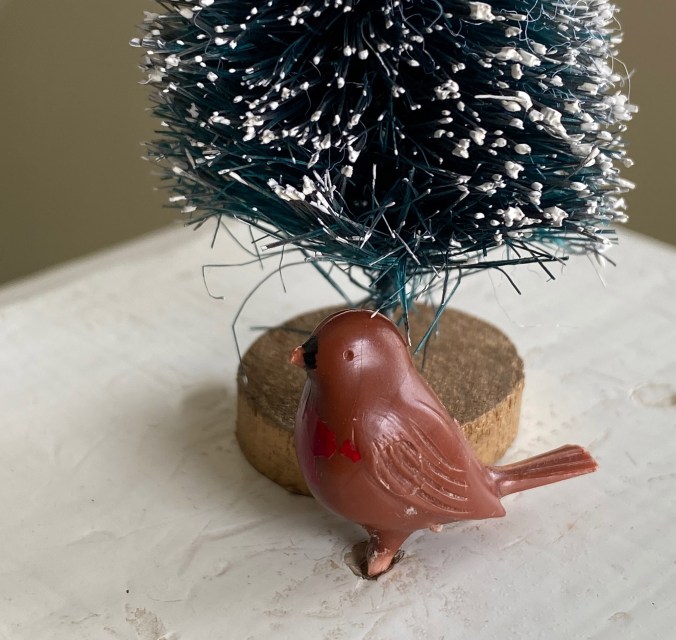
But robins did loom large in my imagination. Each Christmas my mum decorated the snow-peaked ( and rock hard) royal icing on the Christmas cake with with a small flock of plastic robins, to accompany the rather frightening plaster Santa with mis-matched eyes.

Somehow, I still have a single one of these little robins, although most of his red breast paint has now worn off.
Robins were, and still are, as far as I know, featured on cards and stamps to celebrate the Festive Season in Britain. In the Victorian era, when the sending and receiving of festive greeting cards first became fashionable, the mail carriers wore red tunics and were nicknamed robin redbreasts — bringers of winter cheer, just like the birds.
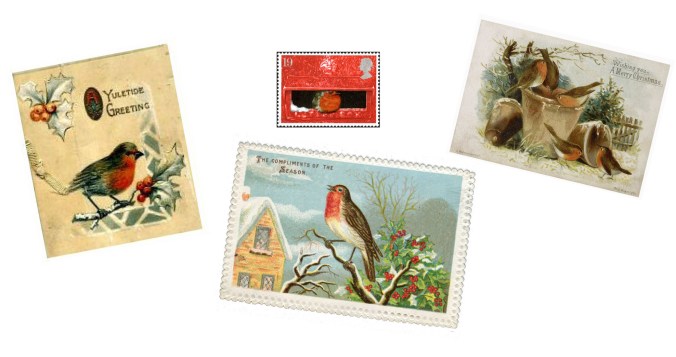
The British robins stay put all year round, but are less obvious in the summer months — probably being busy with nesting and all, and are more associated with chirpy, charming and colourful company through the winter months.

Whenever I go back to Britain I’m constantly on the lookout for a robin. For some reason, the only place I ever see them close up is at the tea rooms of Portmeirion village in North Wales.

Portmeirion Tea Room robin, 2010

Welsh robin on a picnic table

Portmeirion Tea Room robin, 2019

I like to imagine they’re all there, just waiting for me, one robin generation after another.

British robins are very, very territorial, so that’s just about possible. They are so very fierce about defending their home turf that 10% of mature male birds actually die doing just that.

Welsh robin and stone wall photo collage by June Hunter
Having been in Canada now for most of my life, my Robin Reality has now switched to the North American variety, which has its own charm.
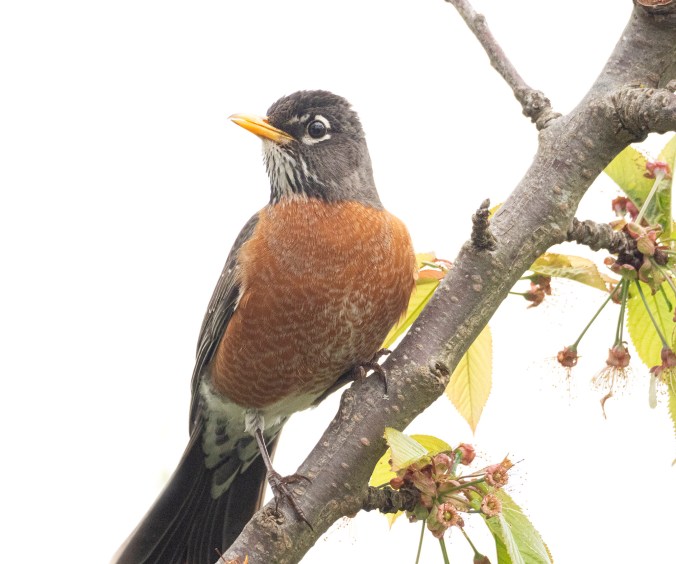
American robin in cherry tree photograph

Seasonally, the robins here are most associated with spring, when they’re the first birds to sing in the morning, and the last to fall quiet at night.

Although we think of them in connection with spring, when their courting song fills the air, they’re actually around all winter here in Vancouver. Perhaps we don’t notice them so much because they behave very differently during the colder months.

American robin camouflaged in gum tree photograph by June Hunter

Spot the robin …

In spring they form pairs and are territorial like their European namesakes, but in winter they live rather cooperatively in large nomadic flocks, sometimes with starlings and other birds, like Cedar Waxwings. They pop up in large groups whenever they find a good source of fruit on trees. Holly, juniper, crabapples and hawthorn are all robin-approved winter fare.

American robin and crabapples photograph by June Hunter

Fun fact: American robins have an extendible esophagus, which allows them to store berries harvested in the daytime for an evening snack to help survive the cold nights.

(I am reminded of the rather terrifying Horlicks TV ads of my youth, where a scientific looking graph traced the worrying arc of “night starvation” — a fate that could only be avoided by imbibing a nice cup of pre-bed Horlicks. I expect night starvation is much more of a reality for a wild robin than for a well fed child of the 1960’s.)

Once spring arrives, the flocks disperse and robins break into pairs, staking out and aggressively defending nesting territory.
When the berries are finished they’ll happily switch to yanking worms out of lawns.

One of my favourite things about the spring and summer robin, apart from the singing, is the gusto with which they take a bath. If the birdbath is suddenly empty, I assume that an enthusiastic robin has just used the facilities.

The folklore around how robins of all types first acquired that fiery red breast is strikingly similar on both sides of the Atlantic. In all versions of the tale,  the brave little robin saves sleeping humans from freezing, using their wings to fan the embers of a dying fire, in spite of the heat and danger. As a reward for their heroism, the robin is awarded the red breast as a badge of honour.

Here’s a beautifully illustrated version of the Sechelt People’s version of the story by Charlie Craigan.

Click fo enlarge

It’s nice to know that however far you travel, they’ll always be some sort of robin to fall in love with.

Echoes of If You Can’t Be with the One You Love, Honey, Love the One You’re With.

Here’s lookin’ at you …


For more posts on the joy of watching robins, and other birds, bathing:


__________________________________________________________________________________________

© junehunterimages, 2021. Unauthorized use and/or duplication of this material without express and written permission from this blog’s author and/or owner is strictly prohibited. Excerpts and links may be used, provided that full and clear credit is given to junehunterimages with appropriate and specific direction to the original content.