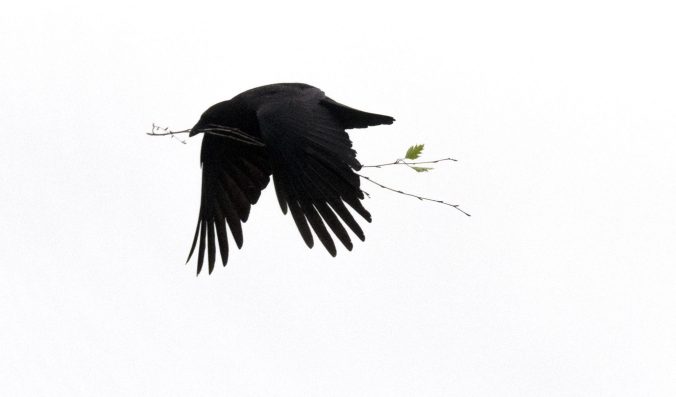
All Quiet On The Nesting Front (For Now)

The crow nesting season goes through various phases, some quiet, others much louder.

Right now we’re in a seemingly tranquil phase

All is secretive and low key as the parents try to keep the nest locations hidden from predators. Sometimes the game is given away when the female, sitting on the eggs, makes begging sounds to remind their mate to hurry up with the food delivery, but generally it’s as if the whole neighbourhood is made up entirely of of very quiet bachelor crows.

Marvin going solo while Mavis sits on the eggs, spring 2022

The mother crow will remain on the nest, incubating 2-6 eggs, for between two and three weeks. Once the eggs hatch, both parents will leave and return to the nest frequently to bring food. Another parental duty is carrying away the babies’ fecal sacs to keep the nest clean. A sure sign of hatched babies is seeing a poop-splattered adult crow — evidence of one of those sacs having failed in the disposal process. The love of a parent truly knows no bounds …

Mr. Walker on dad duty, Spring 2022

This is, of course, the calm before the storm. Soon things will start to get more exciting as dive bombing season begins.

This is such an issue in Vancouver that, a few years back, a Langara College professor created an open-source Geographic Information System called Crowtrax, allowing people to report where they were attacked by crows and thus contribute to a map of the most “crow-terrrorized” parts of the city.

I’m happy to report that there’s been a positive change in the way this part of the crow nesting season in covered by the local media over the past few years. It used to be all Hitchockian horror, with eyeball grabbing headlines about “savage” crows swooping from the sky and randomly mauling innocent pedestrians. In recent times there has been more curiosity about what’s really happening here, and much more thoughtful pieces have been written.

Last year, Georgia Strait reporter, Martin Dunphy, wrote such an article and one of my images was on the front cover.

The article included comments from Vancouver crow scientist, Rob Butler, and myself and was a refreshingly pro-crow look what can be a slightly hysterical time of year.

I have some tips on avoiding getting dive-bombed this year, but first of all it’s helpful understand what’s going on from the crows’ perspective.

The crow parents have been working on this nest since late February, carefully building it, sitting on eggs in secret, carrying bags of baby poop hither and yon, fighting off hawks, raccoons, cats and eagles. They are tired, stressed to the max, and very, very committed to the success of their little families. Now the precious babies are about the leave the relative security of the nest.

These “babies” are almost the same size as the parents at this point, so some people don’t even notice that they’re not adult crows. Sometimes they’re difficult to spot at all as they rest on the ground, camouflaged with dust and leaf litter. They’re often earthbound because, in what seems to be a bit of a design flaw, they come out of the nest before they can fly.

The young crows are curious and eager to explore, but have no idea what might be fun as opposed to fatal. The only things standing between the helpless fledglings and getting stepped on, run over or attacked by animals or birds of prey are good old mom and dad. These exhausted and very tense parents and are the “savage” dive bombers — and it’s really nothing personal, they just want you to STAY AWAY from their precious offspring until they can fly.

In my experience, sometimes the raucous cawing isn’t even directed at us humans. Often they seem to be screaming instructions at their fledging and/or making a lot of racket just to drown out the baby crow noises that might attract real predators.

So try to remember, you’re not in a Hitchcock movie — just a small domestic drama.

TIPS FOR KEEPING YOURSELF AND THE CROWS SAFE

  1. Avoiding the nest area if possible.
  2. If you can’t stay clear, wear a hat or use an umbrella when you walk by.
  3. Try pinning fake eyes (paper drawings, or make some with felt) on the back of your hat or hood. Crows only attack from the rear and if they see a pair of eyes “looking” at them they won’t swoop — according to Seattle crow scientist John Marzluff.
  4. Earn some trust with a small offering of  unsalted peanuts. Not a big pile — just 3 or 4 peanuts as a gesture of friendliness.
  5. This might just be me, but I always speak softly to the parents and tell them what a great job they’re doing.
  6. If you see a crow fledgling alone on the ground, don’t assume it needs rescuing. There will be a parent crow nearby watching over things and, unless the baby is obviously injured, it’s always best to leave it alone.


This following little diagram is something I put together years ago as an easy guide to telling fledgling crows apart from adults …


Once the baby crows are able to fly the parents will become a lot more relaxed and spend a lot of time feeding, grooming and showing the young ones the ropes of being a successful city crow.

Spending time watching this process will reward you with many laughs as you see yourself reflected in the behaviour of the parents, kids, or both.


__________________________________________________________________________________________

© junehunterimages, 2022. Unauthorized use and/or duplication of this material without express and written permission from this blog’s author and/or owner is strictly prohibited. Excerpts and links may be used, provided that full and clear credit is given to junehunterimages with appropriate and specific direction to the original content.

 

Small News

Photo by June Hunter

I walk around the neighbourhood several times a day during nesting season, checking in on the crow news — taking photos and making mental notes of how things are with the various crow families I’ve become acquainted with over the years. 

At this point I’ve got so many crow-notes stuffed into my head, I’m not sure where to start unpacking them. 

Rather than trying to cram all the news into one post, I think I’ll go one crow family at a time, starting with the Pants family in the next post.

First though, I have to tell you about this morning’s drama. 

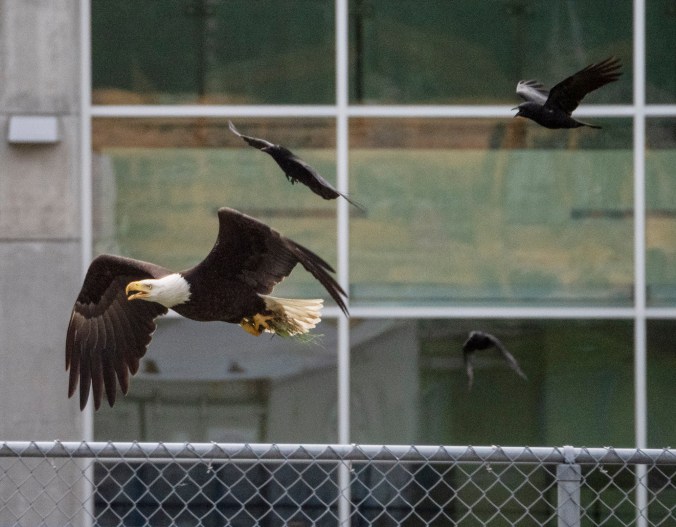
We’ve had nesting bald eagles in the neighbourhood for years, so all through each nesting season the eagle parents scour the area for baby eagle food, always followed by a loud and angry crow posse. This morning I happened to catch some of the action from relatively close quarters when the eagle landed in the school grounds at the end of the block.

The crows, backed up by screeching gulls, seemed even more loud and frantic than usual.

So impassioned, in fact, you can see one crow in the video below whacking the sitting eagle hard enough to cause it to fly off.

The reason they were so mad? It looked as if the eagle had scooped an entire crow’s nest right out of a tree. You can see a glimpse of the nest in the video below.

In the end, the eagle dropped most of the nest, although there was something still gripped in its claws as it flew off.

The eagle population is part of the reason the crows are changing their nesting habits. 

Local ornithology expert, Rob Butler, who spoke about crows last weekend on local CBC Radio show, North by Northwest, mentioned this change: crows who had previously chosen high nest sites for protection against ground based predators (raccoons, cats, coyotes) are now picking spots in lower, less eagle-accessible trees — even selecting quite small street trees they calculate will be awkward for raccoons to scale.

I’ve certainly noticed that our local crows have rejected the once-coveted penthouse suites in the Notre Dame poplars this year in favour of much lower and more camouflaged trees. Marvin and Mavis have picked such a low, mid-street location for the nest this year, it would be quite the drama if the eagle swooped that low. 

If you think being dive-bombed by a crow is exciting …!

The Pants crow family, who I’ll be looking at next time, have long been fans of the low-rise nest building solution and we’ll have a look at what they’re up to this spring.


__________________________________________________________________________________________

© junehunterimages, 2020. Unauthorized use and/or duplication of this material without express and written permission from this blog’s author and/or owner is strictly prohibited. Excerpts and links may be used, provided that full and clear credit is given to junehunterimages with appropriate and specific direction to the original content.

Marvin and Mavis Nesting 2020

I know I haven’t written about my crow neighbours for quite a while. There are a couple of reasons, apart from the distraction of Edgar and the Cabin Fever series.

One: I have just SO MANY images and stories filling up my brain and computer, I’m having a hard time knowing where to start. But, since it’s also time to start thinking about the 2021 City Crow Calendar, it’s time for a dive into Crowlandia.

Two: it is nesting season, which fills me with a certain level of anxiety. Like most of us, I already have a bit of an anxiety surfeit,  so I was trying to keep a slight emotional distance from the rough and tumble of the bird reproductive season.

But I know it’s hopeless, I can’t stop myself from getting invested in the drama.

I’ll start with a bit of an account of Marvin and Mavis’s nesting season so far. I worry especially about these two as they are my regular visitors and, over the past years, I’ve seen them lose three seasons’ worth of fledglings — to racoons, falling-out-of-tree mishaps and bald eagles.

Marvin and Mavis’s nest, May 2019

For the last two springs, they built their nests high in the Notre Dame poplars.

While those trees have the advantage of height and protection from ground predators, they are also a favourite buffet for the local eagles and hawks. All of the local crows seem to have come to the same conclusion, as I haven’t seen any of them building nests there this spring, although they’re still popular with smaller birds.

Marvin and Mavis got an early start on this year’s nest building back in March, choosing a nice dense pine tree. I’m not sure what went wrong with that project, but by April they were real estate shopping again.

They turned their attention to the dark red-leaved plum trees on our street, which offer great camouflage for dark coloured birds.  A couple of problems arose there.

First of all, Mabel and her mate got an earlier start, with their substantial nest all finished in another plum tree weeks ago. With the added advantage of two youngsters born last year hanging around as nest helpers, they’ve been able to wage war on Marvin and Mavis whenever they start a new building project.

Marvin and Mavis warding off a Mabel clan raid from our roof.

On the lookout for incoming raiders

Marvin and Mavis persevered, however, and managed to start a nice looking nest in one plum tree at the far end of the block from Mabel and co.

While it’s wonderful that many people, forced by the pandemic to slow down and stay close to home, have started appreciating their bird neighbours in a new way, it’s also true that it’s given people more time to become very particular about their gardens. Unfortunately for our intrepid couple, the humans whose house they were building in front of decided they did not want to experience the thrill of a crow’s nest so close to them, and started to knock the partly built nest out of the tree. I did try my best friendly Crow Evangelist pitch to get them to leave it alone, and I thought I’d made some progress, but by the next day the nest that Marvin and Mavis had started rebuilding was gone again, so I guess not.

Having read the writing on the wall, M & M selected another plum tree. This is where they are now — trying to be very quiet as it’s rather too close for comfort to Mabel’s nest. Luckily, all of the crows now seem to have entered the “witness protection” phase of the nesting season where they’re all just trying to be invisible from any potential predators.

Mavis checking out the view from the new nest.

Fingers crossed for them this year. I don’t think they have eggs in there yet as both of them have been coming to the house to visit several times a day — for pep talks and some peanuts.

I’m trying not to draw too much attention to their nest as they try to keep a low profile, and hoping that things go well from now on. Fingers crossed for some little Marvins and Mavises this year, even as I try not to get my nerves too jangled at every twist and turn of the nesting tale. I’ll keep you posted …

Some other posts about crow nesting seasons:


__________________________________________________________________________________________

© junehunterimages, 2020. Unauthorized use and/or duplication of this material without express and written permission from this blog’s author and/or owner is strictly prohibited. Excerpts and links may be used, provided that full and clear credit is given to junehunterimages with appropriate and specific direction to the original content.