The Pants Family, Spring 2020

After months operating undercover as an anonymously normal-looking crow, Mr. Pants will soon be coming into his own when, in the next few weeks, his glorious pants shall reappear. 

Photo by June Hunter

For details on the miraculous annual transformation see my earlier post The Metamorphosis of Mr. Pants.

Mr Pants on Fence

Mr P in full trouserly glory

Thankfully, he is no longer the bedraggled bird he was at peak moulting season last year. He got back to being a handsome, if unremarkable looking, crow by late fall.

Photo by June Hunter

Last spring I was away in the UK for the month of June, so I missed a lot of nesting season. For whatever reason, Mr. and Mrs. Pants produced no offspring in 2019, so I’ve been keeping a special eye on their progress this spring.

They had a rather trying fall and winter last year, with territorial trouble on their southern border from the Walker family. While Mr. and Mrs. P had no surviving babies last year, the Walkers did, and their need for more food and their numerical advantage led to bold and frequent incursions into Pantsland.

OLYMPUS DIGITAL CAMERA

Both of the Pants couple spent most of their time with eyes scouring the sky for invading forces and they were very jumpy and seemed … if it is possible to discern this in crows … stressed out.

Mrs. Pants scours sky

Mrs. Pants on guard

Photo by June Hunter

Mr. Pants on Shed Roof

Mr. Pants keeping a wary eye on things from above

Tail fanned Mr Pants Crow

Mr Pants employing full tail regalia to defend his territory.

Now that nesting season is well underway, all the crows are keeping a lower profile and things have at last quietened on the contested border.

Mr. Pants and Wisteria

Mr. Pants takes a relaxed moment to pose with wisteria.

As I mentioned in the last post, Small News, many crows are choosing small street trees as nesting sites of late. While they’re closer to the ground and the risk of predation by racoons, cats, squirrels etc. they’re less likely to be raided by large birds like ravens, hawks and eagles — which seems to be an increasing risk as these birds gain a firmer foothold in the city.

The Pants have long favoured the small tree option and this year is no exception.

I spotted Mrs Pants last week sitting in their nest in quite small street tree  — a crabapple of some sort, I think, and the same type of tree they chose two years ago. Fortunately they seem to have selected a healthier specimen this time, as the spring 2018 tree shed a lot of leaves in spring, leaving poor Mrs. P baking in the sun or thoroughly soaked, depending on the day, and not particularly well hidden. Even then, they did successfully fledge two little ones that year, although, sadly neither made it past the first few months. One just disappeared early on and the other succumbed to avian pox.

Being an urban nature enthusiast involves, as I learn anew every year, witnessing a lot of tragedy and well as joy.

Crow on Nest June 8 2020

Mrs. Pants on the nest this morning

Still, like the crows, we consider each day a new start, and each nesting season a potential bonanza of good news, so fingers crossed for the Pantses and all the other birds putting their all into the nesting business this spring.

Mrs. Pants above nest

Mrs Pants on guard above the nest.


Next up: the Walker Crow Family.


__________________________________________________________________________________________

© junehunterimages, 2020. Unauthorized use and/or duplication of this material without express and written permission from this blog’s author and/or owner is strictly prohibited. Excerpts and links may be used, provided that full and clear credit is given to junehunterimages with appropriate and specific direction to the original content.

Small News

Photo by June Hunter

I walk around the neighbourhood several times a day during nesting season, checking in on the crow news — taking photos and making mental notes of how things are with the various crow families I’ve become acquainted with over the years. 

At this point I’ve got so many crow-notes stuffed into my head, I’m not sure where to start unpacking them. 

Rather than trying to cram all the news into one post, I think I’ll go one crow family at a time, starting with the Pants family in the next post.

First though, I have to tell you about this morning’s drama. 

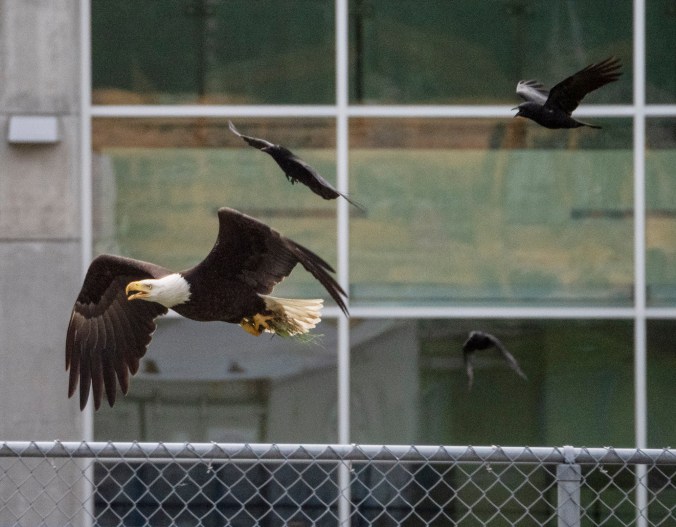
We’ve had nesting bald eagles in the neighbourhood for years, so all through each nesting season the eagle parents scour the area for baby eagle food, always followed by a loud and angry crow posse. This morning I happened to catch some of the action from relatively close quarters when the eagle landed in the school grounds at the end of the block.

The crows, backed up by screeching gulls, seemed even more loud and frantic than usual.

So impassioned, in fact, you can see one crow in the video below whacking the sitting eagle hard enough to cause it to fly off.

The reason they were so mad? It looked as if the eagle had scooped an entire crow’s nest right out of a tree. You can see a glimpse of the nest in the video below.

In the end, the eagle dropped most of the nest, although there was something still gripped in its claws as it flew off.

The eagle population is part of the reason the crows are changing their nesting habits. 

Local ornithology expert, Rob Butler, who spoke about crows last weekend on local CBC Radio show, North by Northwest, mentioned this change: crows who had previously chosen high nest sites for protection against ground based predators (raccoons, cats, coyotes) are now picking spots in lower, less eagle-accessible trees — even selecting quite small street trees they calculate will be awkward for raccoons to scale.

I’ve certainly noticed that our local crows have rejected the once-coveted penthouse suites in the Notre Dame poplars this year in favour of much lower and more camouflaged trees. Marvin and Mavis have picked such a low, mid-street location for the nest this year, it would be quite the drama if the eagle swooped that low. 

If you think being dive-bombed by a crow is exciting …!

The Pants crow family, who I’ll be looking at next time, have long been fans of the low-rise nest building solution and we’ll have a look at what they’re up to this spring.


__________________________________________________________________________________________

© junehunterimages, 2020. Unauthorized use and/or duplication of this material without express and written permission from this blog’s author and/or owner is strictly prohibited. Excerpts and links may be used, provided that full and clear credit is given to junehunterimages with appropriate and specific direction to the original content.

Urban Nature Challenge

“Explore your own neighbourhood,” advises our provincial premier, John Horgan for this long weekend in British Columbia.  We’re all being asked to stay relatively close to home to limit the spread of COVID-19. So, much as I long for the forest and mountains after weeks and months confined to the city, I decided have some fun and set myself a real Urban Nature Enthusiast challenge.

Geordie and I heading out on our urban nature safari.

We headed out to one of the least promising-looking locations, nature-wise, in our East Vancouver neighbourhood.

Our destination was the old Grandview Hydro Substation located at the noisy intersection of First Avenue and Nanaimo Street. This cavernous space is a perennially popular filming location for the local movie industry. From what I can discover, it was built in 1937 as a substation for the BC Electric Railroad Company to help power the old interurban rail lines that once criss-crossed the city.

As the traffic roared past, Geordie and I scouted around for some interesting moss, lichen or rust. I wasn’t really expecting to find much in the way bird life, but the trilling, whistling sound of many starlings lured me around the corner of the building.

The east side of the substation is covered in a cascade of ivy and, at first, that’s all I could see. It took a few moments before I realized that it was alive with starlings; specifically, fledgling starlings, merrily feasting on the ivy’s dark berries. Very few adult starlings were around, making it seem like a massive starling nursery — a relatively safe place to leave the kids while running errands.

Roll call at the starling nursery school.

Apart from the starling crowd, there were some robins and sparrows also enjoying the dining facilities. Nearby, a pair of crows seemed more focussed on another project.

These two were industriously flying back and forth to a nearby tree with a succession of twigs, mud and grass.

First, some structural stuff …

… and then some soft furnishings …

… finally, some scraps of cedar bark fibres, which crows often use to line the nest for its antimicrobial properties.

I thought that was a pretty good dose of urban nature for a trip to an old substation in a busy traffic area next to a gas station and was about to call it a day when I noticed the swallows.

At first I thought they were just more starlings darting around in the sky, but  I could see they were much smaller and more erratic. When one swooped only feet from my head I realized they were Violet Green Swallows!

I tried for quite a while to get a photo of them flying, which is hard enough because of their speed and random direction changes, but just about impossible in an urban area with all the power lines and poles getting in the way of the camera’s focus.

I found the best strategy was to focus on one bird when it stopped on a wire and hope that some others would fly close by. I just had my light “walking” lens with me, so success was limited, but here are few shots of the magical substation swallows.

I grew up in a very industrial part of a northern English town and I spent my childhood playing along the Newcastle quayside, discovering places like this all the time. Forgotten by the grown-ups, slightly dirty, dodgy and dangerous,  but full of adventure and new understanding for free range kids. My substation outing reminded me of those days, and the sense of having made small but amazing discoveries.

If you’re looking for something to do, I really suggest setting yourself an urban nature challenge, checking  out some new part of your local neighbourhood. It’s important to give it a a few minutes of waiting and watching to see what’s going on in the slightly hidden world of nature in the city. Bring the kids — they love a good expedition and, if it helps,  imagine it being narrated by David Attenborough!

A small chickadee making himself heard over the river of traffic.