White Wing the Crow

I don’t think I’ve written about Ms. Wing before, even though we’ve been acquainted for a few years now.

I see her less often than some of my other crow friends because she lives on the outer range of my dog walks. If I go another way, I won’t see her at all — and I didn’t see her for weeks this winter when my foot cast kept me tethered within a smaller radius of home.

But the thing about White Wing is that she knows me instantly, and I know her instantly too. She doesn’t really have a white wing: it’s more of a wonky feather. The first time I saw her, about three years ago, the light hit the crooked feather in a way that made the whole wing look snowy, so her name stuck.

And White Wing does sound more romantic than Wonky Feather, right?

I thought I’d write about her now because, while the present moment is really tough in most ways, it IS a good time to get out and get to know some local crows — and Ms. Wing is good example of the kind of crow that can be the key to starting to figure out the Who’s Who of your local crow-munity. Solving that identity puzzle is good motivation to get out for a walk, and figuring it out can be a great distraction from other news.

As soon as I’m near the block that the Wing family lives on, I can tell for sure that, of all other crows, this one is definitely her. Even from a distance.

And I can tell that her companion must be Mr. Wing. I determined that she is the Ms. in the equation because, of the two of them, she’s the one who disappears for a few weeks during the nesting season when she’s sitting on the eggs. Mr. Wing doesn’t really have any distinguishing features, but I can identify him because of his proximy to Ms. Wing.

This is how Crow Cluedo works.

A couple of times a year, at moulting season, and sometimes during nesting, White Wing’s twisted feather comes out, and she looks, briefly, like any other crow.

However, it always grows back in the same crooked way and, luckily, it doesn’t seem to affect her flying ability … or her self esteem.

Mind you, she can look just as bedraggled as any of the crows on a wet day …

As I mentioned, I didn’t see her for at least a couple of months over the winter, but as soon as I got to “her” corner she picked me out and came down, with a slightly aggrieved expression, as if to say “where the heck have you been?”

Most of the crows I’m lucky enough to have become acquainted with have some sort of physical anomaly that allows me to pick them out from the crowd.

  • Mabel has one damaged eye
  • Mr. Pants has his pantaloons, in season
  • Marvin, when he first appeared has somehow spilled paint on himself, which lasted all summer until moulting
  • George had his broken beak (although it was intact when we first met.)

Sometimes the differences are easily visible, like White Wing’s feather.

Things like Mabel’s damaged eye are harder to spot, but I have my long camera lens to help out. A small pair of binoculars would do the trick too.  Crows are very territorial during the day, so if you see the same “different” bird in the same spot a few times in a row — congratulations — you’ve solved the first layer of the corvid Rubik’s Cube!

Mabel the Magnificent

See also: Peanut Diplomacy.

Stay safe everyone, and try to balance the understandably constant craving for news with a spot of Crow Therapy.

Some other posts you might enjoy at this unsettled time:


__________________________________________________________________________________________

© junehunterimages, 2020. Unauthorized use and/or duplication of this material without express and written permission from this blog’s author and/or owner is strictly prohibited. Excerpts and links may be used, provided that full and clear credit is given to junehunterimages with appropriate and specific direction to the original content.

Consider the Bushtit …

Yes, let us drag our minds away from the headlines for a few moments to consider the many amazing things about this rather drab, and somewhat unfortunately named little bird.

And it really is minuscule, weighing in at about 5.3 grams — approximately the weight of one nickel. It’s one of the tiniest songbirds, coloured a modest beige-grey and, with it’s squeaky call, very like a flying mouse.

You can see how really tiny they are when they decide to take a bath. I remember how shocked I was as kid when I saw my aunty’s Yorkshire Terriers soaking wet.

Similar effect with bushtits.

It’s hard to decide what I like most about bushtits, but high on the list has to be their nest making technique. Essentially, they weave an elastic sock out of moss, grass, lichen, leaves, small twigs.

A bushtit nest I found lying on the ground after nesting season a few years ago. It measures about 25 cm (10-inches) from top to bottom.

The ingenious addition of spider web to the construction is what makes them stretchy — a handy feature as both parents, possible extra helpers and, eventually, 5-7 baby bushtits, will all be snuggled in there at one time. The interior is made extra cosy with a lining of downy plant material and feathers, while the outside is camouflaged with the addition of material from nearby foliage.

You can see a bushtit popping his head out of the nest, top left.

Another bushtit bonus: they generally come in bulk. It’s rare to see one by itself as they arrive in the garden like an excited tour group on a very tight schedule. One minute there are zero bushtits, then there are thirty. They’ll crowd the local attractions, tweeting their reviews, before abruptly weaving off en masse to the next stop on the itinerary.

They love suet, but they also like the finch feeder — and I’ve even seen them  drink from the hummingbird feeder on occasion.

Another thing for gardeners to love about bushtits — they will eat aphids from your plants! They also enjoy small spiders and other bugs that live on the underside of leaves. Their small size gives them the advantage of being able to hang underneath leaves and access a bug harvest there that’s inaccessible to bigger birds.

Me next!

One of the very most amazing things that I’ve just recently noticed about bushtits is that they can hold food in their little claws and eat it like a sandwich. I thought my eyes were deceiving me at first, so I spent quite a bit of time trying to get a decent photo. Not so easy, as those feet are so tiny and so fast, but here are a few of my efforts to capture the Bushtit Sandwich Effect.

I’ve not noticed any other of our local birds using such a prehensile-like feeding technique, and I honestly don’t remember seeing bushtits doing this until the last few months, so I sort of wonder if it’s one of those miracles of city bird adaptation.

Still need more amazing facts about bushtits? OK, how about the fact that, despite their tiny size and uniform colour,  you can easily tell the males from the females by their eyes? The males have dark, button-like eyes, while the females have light coloured ones — pale gold in our part of the world — giving them that intense “Angry Bird” look I do so love.

Male Bushtit

Female (don’t mess with me) Bushtit

The photo above became the basis of one of my most recent bird portraits of “Agnes, the smallest but by far the most furious of the Furies.”

Do you sometimes hear a small shrub alive with tweets, and then the bush seems to deconstruct before your eyes into a living Escher-like bird design — and it’s bushtits heading off somewhere else? That’s another thing I love about them. They’re magic.

So, while there are definitely a lot of massively worrying things going on in the world right now, this is a small (tiny, really) reminder that there are still many good and amazing things going on all around us — under leaves, inside mossy sock-nests, or flying around in judgemental little groups.

Sometimes, for your own mental health, you just need to Consider the *#@*!! Bushtit …


You may also enjoy:


__________________________________________________________________________________________

© junehunterimages, 2020. Unauthorized use and/or duplication of this material without express and written permission from this blog’s author and/or owner is strictly prohibited. Excerpts and links may be used, provided that full and clear credit is given to junehunterimages with appropriate and specific direction to the original content.

A Small Care Package

I had meant to write another crow update blog post today, but somehow it was a bit hard to focus on pulling the images and words together.

So, instead, here is a small, somewhat random bouquet of things that are helpful for my mental health at this tough time. I hope they help you too.

First, here is Norman the Nuthatch visiting the garden this morning.

It’s just 5 seconds, but I find playing him over and over again kind of restful.

Second, here is Mr. Pants, looking at me from the wires on our morning dog walk.

Crow Therapy is proving to be a lifeline for me at the moment.

Third, in exceptionally good timing we have Luke the Super Emotional Support dog staying with us for the weekend. Triple-strength dog therapy with Geordie and Nina. They take their work very seriously.

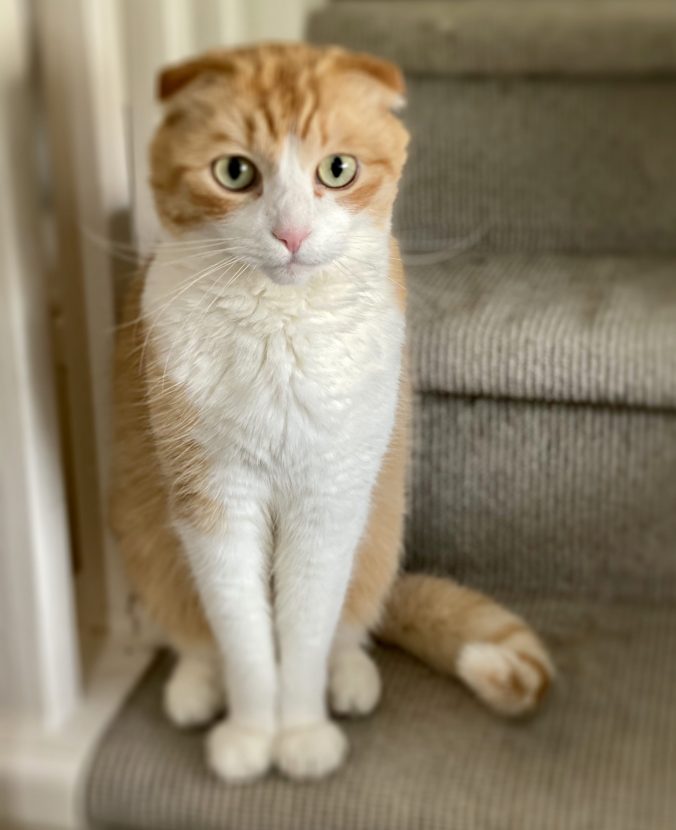
Fourth, and last, we need Edgar’s advice …

As an indoor cat he is already a master of both social distancing and extreme cleanliness.

Further advice he would like to share:  stay safe, nap frequently, and be very kind to others.


__________________________________________________________________________________________

© junehunterimages, 2020. Unauthorized use and/or duplication of this material without express and written permission from this blog’s author and/or owner is strictly prohibited. Excerpts and links may be used, provided that full and clear credit is given to junehunterimages with appropriate and specific direction to the original content.