Downy Dating Tips

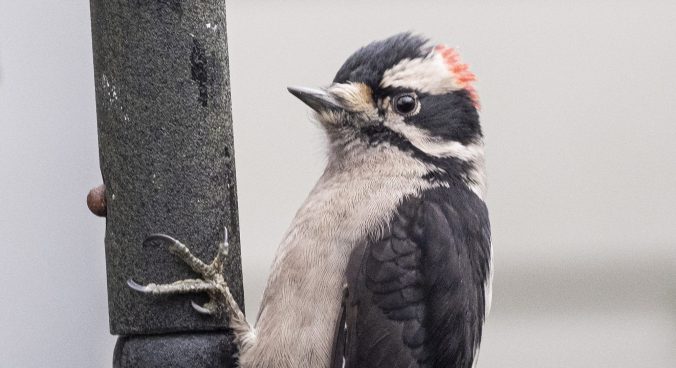
The Downy Woodpecker is the smallest of all the North American woodpeckers, a compact and handsome little bird, often found in urban backyards.

The male wears a jaunty red cap, while the female restricts her fashion palette to a crisp and dapper black and white.

They are firm believers in the saying “good things come in small packages.”

I was out walking the dog a few mornings ago and heard what sounded like a small jackhammer. A bit rude to be working on a construction project so early, I thought.

But, getting closer to the hammering, I realized the source was the top of a Hydro pole. I then assumed that it was the usual suspect — the amorous male Northern Flicker looking to impress the ladies.

I stared at the pole for quite a while without being able to spot the percussionist. It took my camera lens finally pick him out — a tiny, but talented, male downy woodpecker.

He was exploring the whole T-bar of the pole, testing here and there to find the best reverb. And he’d found the sweet spot for sure, making a noise that echoed richly around the neighbourhood.

So impressive did he sound — he finally attracted a  female Northern Flicker to his perch.
They both looked at each other as if they’d arrived on a blind date . . . and both parties had stretched the truth in their dating profiles.

You can see Mr. Downy trying to look inconspicuous on the far right.

After an awkward moment or two, the downy made a quiet exit stage right — off in search of his true love.

Here’s the actual object of his affections, taking a little spa time at our bird bath. I’m hoping they’ve sorted the confusion out now and that we can look forward to some even littler downies later in the season.

Incidentally, my very first blog post, written in spring 2014 was about a Downy Woodpecker. You can read it here: Downy Woodpecker Drama

Two big things to take away from the 2014 story:

  1. Keep your cat indoors
  2. Donate to your local wildlife rescue centre. Nesting season is always an extra busy time for these volunteer run organizations, especially as they try to work through the Covid-19 complications, so help them out if you can. The organization that saved the downy in 2014 (and countless other birds and other wildlife before and since) is Wildlife Rescue BC.
 

__________________________________________________________________________________________

© junehunterimages, 2020. Unauthorized use and/or duplication of this material without express and written permission from this blog’s author and/or owner is strictly prohibited. Excerpts and links may be used, provided that full and clear credit is given to junehunterimages with appropriate and specific direction to the original content.

Hummingbird Tonic

Well, I think what today needs is . . . hummingbirds!

Luckily (unlike toilet paper) they are in decent supply around here. After a bit of a scarcity over the past few weeks, I had two Anna’s Hummingbirds come by this week.

These days, a special bird visitor is the equivalent of a wild party.

It’s certainly a blessed “stop anxiously listening to the radio and obsessively bleaching surfaces” moment.

So, in case your hummingbirds haven’t arrived yet, here are my recent visitors for some vicarious hummingbird therapy.

First we had a male Anna’s stop by a few days ago to check out the intoxicatingly scented Daphne Odora.

I imagine the nectar of the daphne must be exquisite to the discerning hummingbird palate

Post lunch pause. He had to clean some pollen off his beak and stuck around to enjoy the view.

Bit of a nap/meditate …

A good wing stretch … and then off he flew.

Yesterday I put fresh hummingbird nectar out and it seemed as if this female had been just waiting for it to be served.

Photo by June Hunter

Next, she went to check out the fountain. I noticed last year that they seem to like the running water in the fountain better than the static bird bath.

(See Novice Hummingbird)

She would take some sips of water from the bird bath and then go for a quick fly-through shower under the stream of water.

Then time to dry off in the lilac tree …

… followed by a snack and a perch on the purple rhododendron.

Then she was off again, pursuing her hummingbird adventures. I’m hoping they have a nest nearby and that we’ll be seeing both of them again soon, perhaps with babies.

Stay tuned for some #raventherapy coming up later this weekend!


__________________________________________________________________________________________

© junehunterimages, 2020. Unauthorized use and/or duplication of this material without express and written permission from this blog’s author and/or owner is strictly prohibited. Excerpts and links may be used, provided that full and clear credit is given to junehunterimages with appropriate and specific direction to the original content.


Northern Flicker Gymnastics

The Squirrel Buster bird feeder is an ingenious contraption. When anything heavier than a small bird (say, a squirrel for example) lands on the perch to get at the food, their own weight causes little doors to close on all the seed ports. Northern Flickers are also, technically, too heavy to use this feeder but, even though they have a couple of other food options to chose from, they clearly take this a personal affront.

Luckily they have their secret weapon, the mindbogglingly long tongue they keep neatly wrapped around their brain and ready for instant deployment. All woodpeckers have very long tongues, usually with barbed ends for catching prey, but the Northern Flicker has the longest of all of them, and their tongue tip is flattened and comes with extra sticky saliva for collecting the ants that they find so delicious.

So, back to the Squirrel Buster conundrum.

This male Flicker (you can tell by the red “sideburns”) has figured out that by hanging from the perch he can j-u-s-t get his tongue into the the gap at the bottom of the closing door. I was a bit worried he’d get his tongue stuck and we’d have a difficult conversation with the Wildlife Rescue team, but it seems he’s done this before.

Not only did he get the food out quite handily, he managed to also pick up the bits that fell out of the feeder and landed on his belly. This is where the really impressive gymnastics come in.

I’m pretty sure I saw these two, taking a break from digging up ants, exchanging bird feeder foiling tips on my dog walk the other day.

And, just in case you think it’s only the males who have figured this out, here’s a female I saw doing it in back February, so perhaps she passed on the technique to her mate.

Speaking of ingenuity I’ve been scanning the internet for COVID-19 mask making patterns, as it seems that medical advice here in North America is now pivoting in favour of mask-wearing for all to help “flatten the curve”.

So, just in case you’re also thinking about making your own mask, I’ve looked at a few and made a couple of versions for when someone from our family needs to go out for groceries. The one I like best is this one from the University of Minnesota. It seems to have a good fit, and it has a pouch to put replaceable home-made filters in (suggestions for filter material you can find about the house are included in the instructions.)

If you don’t have a sewing machine, these instructions for a no-sew mask using only a bandana and a couple of hair ties looks promising.

Stay safe and healthy everyone, and remember to take a break from the news and the graphs from time to time with some daily #birdtherapy.


__________________________________________________________________________________________

© junehunterimages, 2020. Unauthorized use and/or duplication of this material without express and written permission from this blog’s author and/or owner is strictly prohibited. Excerpts and links may be used, provided that full and clear credit is given to junehunterimages with appropriate and specific direction to the original content.