Small News

Photo by June Hunter

I walk around the neighbourhood several times a day during nesting season, checking in on the crow news — taking photos and making mental notes of how things are with the various crow families I’ve become acquainted with over the years. 

At this point I’ve got so many crow-notes stuffed into my head, I’m not sure where to start unpacking them. 

Rather than trying to cram all the news into one post, I think I’ll go one crow family at a time, starting with the Pants family in the next post.

First though, I have to tell you about this morning’s drama. 

We’ve had nesting bald eagles in the neighbourhood for years, so all through each nesting season the eagle parents scour the area for baby eagle food, always followed by a loud and angry crow posse. This morning I happened to catch some of the action from relatively close quarters when the eagle landed in the school grounds at the end of the block.

The crows, backed up by screeching gulls, seemed even more loud and frantic than usual.

So impassioned, in fact, you can see one crow in the video below whacking the sitting eagle hard enough to cause it to fly off.

The reason they were so mad? It looked as if the eagle had scooped an entire crow’s nest right out of a tree. You can see a glimpse of the nest in the video below.

In the end, the eagle dropped most of the nest, although there was something still gripped in its claws as it flew off.
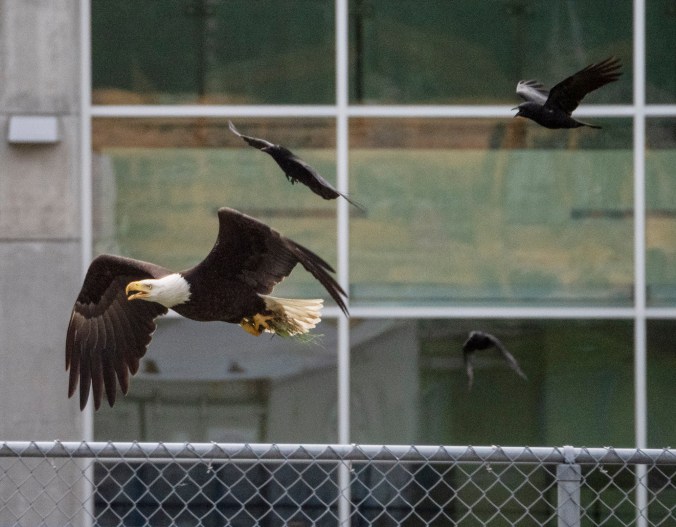
The eagle population is part of the reason the crows are changing their nesting habits. 

Local ornithology expert, Rob Butler, who spoke about crows last weekend on local CBC Radio show, North by Northwest, mentioned this change: crows who had previously chosen high nest sites for protection against ground based predators (raccoons, cats, coyotes) are now picking spots in lower, less eagle-accessible trees — even selecting quite small street trees they calculate will be awkward for raccoons to scale.

I’ve certainly noticed that our local crows have rejected the once-coveted penthouse suites in the Notre Dame poplars this year in favour of much lower and more camouflaged trees. Marvin and Mavis have picked such a low, mid-street location for the nest this year, it would be quite the drama if the eagle swooped that low. 

If you think being dive-bombed by a crow is exciting …!

The Pants crow family, who I’ll be looking at next time, have long been fans of the low-rise nest building solution and we’ll have a look at what they’re up to this spring.


__________________________________________________________________________________________

© junehunterimages, 2020. Unauthorized use and/or duplication of this material without express and written permission from this blog’s author and/or owner is strictly prohibited. Excerpts and links may be used, provided that full and clear credit is given to junehunterimages with appropriate and specific direction to the original content.

Urban Nature Challenge

“Explore your own neighbourhood,” advises our provincial premier, John Horgan for this long weekend in British Columbia.  We’re all being asked to stay relatively close to home to limit the spread of COVID-19. So, much as I long for the forest and mountains after weeks and months confined to the city, I decided have some fun and set myself a real Urban Nature Enthusiast challenge.

Geordie and I heading out on our urban nature safari.

We headed out to one of the least promising-looking locations, nature-wise, in our East Vancouver neighbourhood.

Our destination was the old Grandview Hydro Substation located at the noisy intersection of First Avenue and Nanaimo Street. This cavernous space is a perennially popular filming location for the local movie industry. From what I can discover, it was built in 1937 as a substation for the BC Electric Railroad Company to help power the old interurban rail lines that once criss-crossed the city.

As the traffic roared past, Geordie and I scouted around for some interesting moss, lichen or rust. I wasn’t really expecting to find much in the way bird life, but the trilling, whistling sound of many starlings lured me around the corner of the building.

The east side of the substation is covered in a cascade of ivy and, at first, that’s all I could see. It took a few moments before I realized that it was alive with starlings; specifically, fledgling starlings, merrily feasting on the ivy’s dark berries. Very few adult starlings were around, making it seem like a massive starling nursery — a relatively safe place to leave the kids while running errands.

Roll call at the starling nursery school.

Apart from the starling crowd, there were some robins and sparrows also enjoying the dining facilities. Nearby, a pair of crows seemed more focussed on another project.

These two were industriously flying back and forth to a nearby tree with a succession of twigs, mud and grass.

First, some structural stuff …

… and then some soft furnishings …

… finally, some scraps of cedar bark fibres, which crows often use to line the nest for its antimicrobial properties.

I thought that was a pretty good dose of urban nature for a trip to an old substation in a busy traffic area next to a gas station and was about to call it a day when I noticed the swallows.

At first I thought they were just more starlings darting around in the sky, but  I could see they were much smaller and more erratic. When one swooped only feet from my head I realized they were Violet Green Swallows!

I tried for quite a while to get a photo of them flying, which is hard enough because of their speed and random direction changes, but just about impossible in an urban area with all the power lines and poles getting in the way of the camera’s focus.

I found the best strategy was to focus on one bird when it stopped on a wire and hope that some others would fly close by. I just had my light “walking” lens with me, so success was limited, but here are few shots of the magical substation swallows.

I grew up in a very industrial part of a northern English town and I spent my childhood playing along the Newcastle quayside, discovering places like this all the time. Forgotten by the grown-ups, slightly dirty, dodgy and dangerous,  but full of adventure and new understanding for free range kids. My substation outing reminded me of those days, and the sense of having made small but amazing discoveries.

If you’re looking for something to do, I really suggest setting yourself an urban nature challenge, checking  out some new part of your local neighbourhood. It’s important to give it a a few minutes of waiting and watching to see what’s going on in the slightly hidden world of nature in the city. Bring the kids — they love a good expedition and, if it helps,  imagine it being narrated by David Attenborough!

A small chickadee making himself heard over the river of traffic.

The Charm of Goldfinches

While social gatherings of the human sort are still not an option, we’ve been lucky to host a succession of very charming avian guests in the garden lately.

This week seems to be goldfinch week out there, with beautiful singing and frequent flashes of saffron in the foliage … and at the fountain.

The recklessness of some of the flying manoeuvres I’ve witnessed today lead me to believe that a new generation of goldfinches have come to play. You know when you have to duck to avoid finch/human contact that you have some L-plated flyers in the ‘hood.

Juvenile American Goldfinch

Junior goldfinch taking a breather.

A few years ago we only had house finches coming to the garden. About five years ago the goldfinches finally arrived, but the house finches disappeared. I thought they might be fundamentally incompatible, but last year and this year, both kinds of finches seem to be happy in the garden, along with a gang of feisty siskins.

Male House Finch feeds a nesting Female.

Fierce little siskin bossing Norman the Nuthatch about at the feeder.

This week’s warmer weather inspired me to set up the mister at the bird bath. First customer was a rather excited female Anna’s hummingbird.

Hummingbirds don’t normally frequent the bird bath as they get all the liquid they need to drink from nectar, and the water in it is too deep for them to bathe in. For bathing they prefer either a mist or a shallow water receptacle, like the leaf I noticed a hummingbird bathing in last year.

Birds like the white crowned sparrow below, however, are very, very happy with a regular bird bath — as long as it’s kept nice and clean, with fresh water added daily.

Our hummingbirds also seem to enjoy the fountain, where they can dart under the falling water for a quick feather refresh.

The goldfinches are also big fountain fans for some reason.

Freshly bathed and ready to impress some lady goldfinches.

I hope that you’re also managing to spend some time with feathered friends.

Last week’s local newspaper, the Vancouver Sun, featured a story Backyard Birding Takes Flight about the delight that people stuck at home are finding in getting to know their avian neighbours, and the joy of discovery to be found within their own neighbourhoods. I do hope this is something we’ll take forward with us long after the COVID-19 situation has passed. You will notice that Norman the Nuthatch and one of my Steller’s Jay photos are featured in the article, and I am quoted in it.

You can read the article online HERE.

Treat yourself this weekend to just a few minutes of bird watching. You don’t have to go far at all and you can maintain your social distance. Tomorrow, May 9, offers the chance to do that and be part of a world wide community of bird enthusiasts contributing to science for the Global Big Day of bird observing and counting. You can spend all day doing it, or ten minutes. If you want to add your findings to the overall count, you’ll need an eBirds account. It’s totally free to sign up and participate.

I can honestly say that thing that calms me down the fastest in these days of specific and generalized anxiety is to just stop what I’m doing, step outside and look around to see what the birds are doing. Sometimes a minute does it, sometimes a whole hour is required. Often there seems to be nothing of interest going on, but there always is if you just take a few deep breaths and wait. Common birds doing their normal amazing things, and occasionally a rarer bird. Either way it’s time well spent.

Swainson’s Thrush in the garden last week — only the second one I’ve ever seen.