Best Laid Plans

One of my most vivid childhood memories is sitting beside my mother where she’d tripped and fallen on the sidewalk while rushing for the bus to go shopping. “More haste, less speed,” she said, through gritted teeth. She had a pithy saying for every occasion, my mum, and most them were/are very true. We never did go shopping that day, or for many days thereafter, as she’d sprained her ankle quite badly.

I had great plans for this festive season. Finish up the local sales events early,  leaving lots of time to update my online shop, go for long walks and catch up on the local crows and maybe even get some snowshoeing (ravens!)  in before Christmas. Leisurely holiday shopping in the local shops, baking,  …

Well, you can see how I was asking for trouble.

Like Icarus flying too close to the sun, here I am this festive season.

It seems to be a family tradition now, the pre-Christmas disaster. The worst was Phillip’s concussion from a bicycle accident a few years back. The most hilarious (although only in retrospect) was 2016 when Lily’s dog got sprayed by a skunk at 11pm on Christmas Eve.

The sore foot I noticed the week before the studio sale turned out to be a stress fracture. What with one thing and another, it took quite a while for the x-ray results and to get fitted for the stylish new boot, with a few days when I really could hardly get about at all.  I was starting to feel pretty sorry for myself.

But, another one of my mother’s favourite sayings was “worse things are happening at sea,” and this seems to fit well into that category. We do have the Christmas tree up, and as long as I can hobble as far as the garden, or even the deck, I have some spectacular company.

It was a bit wet this morning, but Marvin and Mavis were, as always, on hand to say hello.

Moist Marvin

Mavis

I think Mavis holds me partially responsible for the change in weather.

In the garden on the weekend, there was a positive Who’s Who of bird visitors coming by to cheer me up.

The most handsome Spotted Towhee

Towhees are new to the garden this year. Always a thrill to see that oh-so-stylish and dotty colour combination.

The world’s most winsome White Crowned Sparrow.

Sweetest Song Sparrow.

Cheery Chestnut-Backed Chickadee

Jolly Junco

I’m noticing that some of the juncos I’m seeing lately have more chestnut on their hoods than I remember in the past. I always thought they were more uniformly grey or black, so I wonder if there is some sort of avian gene pooling going on there.

Heavenly Hummingbird

For years we’ve had one single Anna’s Hummingbird visit the garden all year round. Recently she has found a friend with whom to squabble about the hummingbird feeder.

Natty Nuthatch

I’d never seen a nuthatch until this one started frequenting the garden a couple of months ago. I can always tell when he’s around by the honking sound. At first I thought it was someone’s car alarm going off!

Rosy House Finch

A couple of weeks ago I noticed a couple of house finches with eye problems in the garden. Internet research revealed that there is a very contagious eye disease that spreads among finches, and advice was to bring the bird feeders in for a week or so, meanwhile cleaning them thoroughly with a bleach solution (rinsing well.) I just put the feeders out again a couple of days ago and the birds are celebrating, but I’m keeping a close watch on the finches — and planning on cleaning the feeders every week from now on.

Fabulous Flicker

Flicker Face Off

Probably a stern Flicker look for her old nest rival, the starling.

And, when my foot is starting to throb and it’s time to head inside for a sit down, there’s even more great company in there.

Can I get you a cup of tea …?

Festive Feline

The human company is pretty good too!

Finally, in late breaking news, Marvin has declared that the City Crow Calendar, 2020 Edition has passed the all important corvid taste test!

Hmm, could use a little ketchup, but otherwise, not bad …

www.junehunter.com


_________________________________________________________________________________________

© junehunterimages, 2019. Unauthorized use and/or duplication of this material without express and written permission from this blog’s author and/or owner is strictly prohibited. Excerpts and links may be used, provided that full and clear credit is given to junehunterimages with appropriate and specific direction to the original content.

Crow Collective

In spite of local squabbles, crows will come together for a crisis. Instantly.

Border skirmishes, crow etiquette lapses, hereditary rivalries  — all forgotten in a corvid heartbeat when the alarm call goes out.

Peregrine falcon in the ‘hood!

People sometimes consider crows’ mobbing behaviour towards larger birds as somehow mean. The collective noun, a “murder” of crows, is referenced, darkly.

To me, it’s one of their more admirable features — having the sense to know that they’re stronger together, and the ability to put aside individual differences in the face of a common danger.

Raccoons, coyotes, eagles, hawks, falcons, owls and even their own cousin, the raven, are considered enemies by crows. All of these creatures will snatch and eat juvenile crows and/or crow eggs, thus earning themselves a permanent spot on the crows’ “naughty” list.

It’s not that they’re really naughty, of course — just doing what nature dictates — going out grocery shopping for the family. The same applies to crows when they feed on smaller birds, and on through the spiralling circle of life.

While nesting season is over now, and most juvenile crows are now smart and fast enough to stay out of the way of the falcon (who is more likely on the lookout for a tasty pigeon) the crow response to a “sometimes-crow-predator” in the neighbourhood is automatic.

Every crow drops what they’re doing and flies off to join the collective effort to repel the enemy. Their job is to convince the “threat” that crows are just way too much bother and get them to move along and become someone else’s problem.

Individual crows will swoop very close to the offending predator. Sometimes too close for their health. Generally, however, the bird of prey will make a pragmatic cost/benefit calculation as to whether it’s worth the caloric output to chase a provocative crow. Most often they decide to wait out the mob for a while and eventually move on to a quieter spot.

All in all, I think “collective” is a much better, and more descriptive, word for a group of crows than a “murder.”

Apart from group defence, another advantage of crow mobbing behaviour is that, if you pay attention, you can catch glimpses of things that would otherwise go unnoticed.

For other posts about crow-revealed nature sighting:

Raccoons: Wall of Sound

Owls: Owl Dreams

Owls and Poets: Owls, Crows, Rooks and Poetry

Ravens: Raven Tutor

Missing Dogs: A Christmas Miracle — With Crows


_________________________________________________________________________________________

© junehunterimages, 2019. Unauthorized use and/or duplication of this material without express and written permission from this blog’s author and/or owner is strictly prohibited. Excerpts and links may be used, provided that full and clear credit is given to junehunterimages with appropriate and specific direction to the original content.

Conflict Resolution

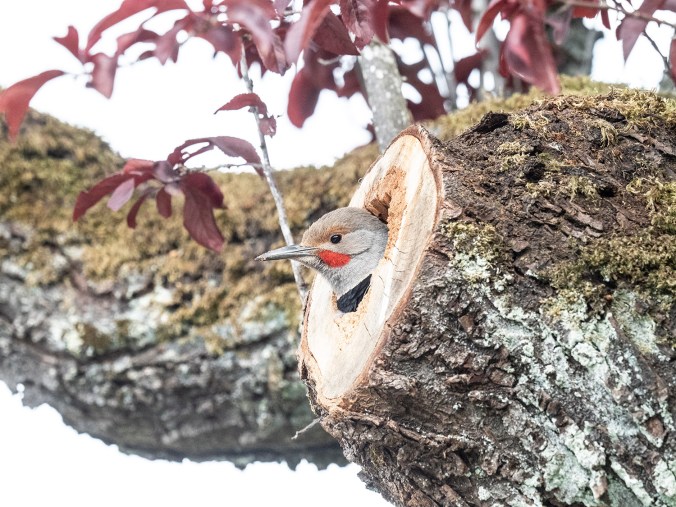
Well, I’m not sure if they did it by guile, by force, or by consulting the Office of the Housing Ombirdsman, but somehow the Northern Flickers have regained occupancy of their nest.

As you may recall, it wasn’t looking good for them in the last post, Battle of the Nest. The Starlings had moved right in and were even installing  their own furniture.  And yet, when I went by the next day, this familiar head was defiantly sticking out of the nest.

I check every time I go by and almost every time there is a  Northern Flicker sentry at the door. Mom or dad are on duty 24/7 to ward off future home invasions.

Oops, looked unguarded for a minute there, but a closer look reveals mother Flicker on the upper deck keeping an eye on things.

Still some last minute renovations going on too.

Meanwhile, what of the starlings?

I must admit I was rooting for the Northern Flickers, given that they were in the nest first and had done all the hard work of digging it out. Fair play and all, right?

It can be hard to sympathize with the starlings, and yet . . .

It’s really not the Starlings’ fault that a well meaning, homesick, but misguided English immigrant (human) released a bunch of them in Central Park, NY in 1890. His goal was to eventually introduce every bird mentioned in the works of William Shakespeare to North America, but the starling was his great “success.” A great example of “be careful what you wish for.”

Neither is it their fault that they’re tough and adaptable birds so that now there are many millions of them in North America, competing with native birds for habitat, food and nest sites.

A few other things in defence of the Starling:

  • If you still really think you can’t appreciate starlings (and remember, a lot of people felt that way about crows until quite recently . . . ) I really recommend reading Mozart’s Starling by Lyanda Lynn Haupt.

So . . . what happened to the Starling invaders of the Flicker nest? Well, it seems they just moved one tree over and took over the tree cavity that was used by Flickers for the 2017 nesting season (recorded in Flicker Family Saga Part One and Part Two. ) It’s been vacant since then, so they moved in without any drama and everyone seems to be getting along for the time being.

Just to be on the safe side, the male Flicker makes regular and  emphatic pronouncements regarding property and tenancy rights.